So you want to make something that looks like it came from a Paris bakery but actually came from your kitchen? Millionaire macarons are your answer. I made my first batch on a rainy Tuesday, half-convinced I’d ruin them, and instead ended up hooked for life.
Servings: Makes about 24 filled macarons (roughly 12 servings) Prep time: 45 minutes Rest time: 30 minutes before baking, plus 2-4 hours after filling Bake time: 15-20 minutes Total time: About 4-5 hours, mostly hands-off
Why “Millionaire” Macarons, Anyway?
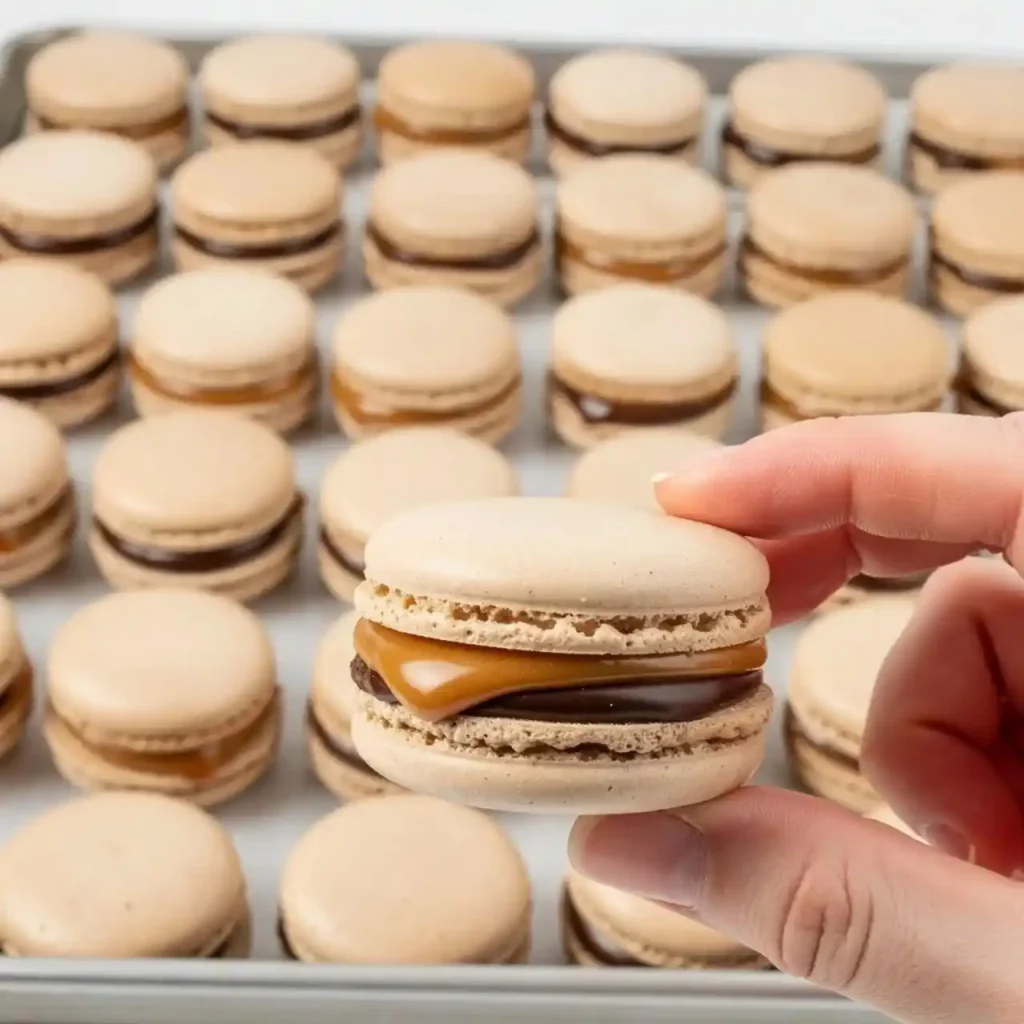
The name borrows from millionaire’s shortbread, that classic combo of shortbread, caramel, and chocolate. Here, we swap the shortbread base for a delicate almond meringue shell. IMO it’s an upgrade.
You get crisp, chewy macaron shells sandwiching a rich caramel layer and a silky dark chocolate ganache. Add a sprinkle of crushed shortbread for crunch and you’ve got dessert royalty.
What You’ll Need for the Macaron Shells
Before we get into technique, let’s talk ingredients. Precision matters here more than almost any other baked good, so grab a kitchen scale if you have one.
- Almond flour: 200 grams, finely ground and sifted
- Powdered sugar: 200 grams, sifted alongside the almond flour
- Egg whites: 150 grams, aged at room temperature for a few hours if possible
- Granulated sugar: 50 grams, added gradually while whipping
- A pinch of salt
- Optional: a small pinch of cream of tartar to stabilize the meringue
Have you ever wondered why macaron recipes are so obsessive about weighing everything in grams? It’s because macarons are basically edible chemistry, and even a little extra moisture throws off the whole structure.
Building the Shells Step by Step
Start by sifting the almond flour and powdered sugar together into a bowl. Do this twice if you’re feeling thorough. This gets rid of lumps and gives your shells that smooth, glossy top everyone associates with real macarons.
Next, crack open your egg whites and pour them into a clean, dry mixing bowl. Any trace of fat or yolk will stop them from whipping properly, so wipe your bowl with a bit of vinegar or lemon juice first if you’re not sure it’s spotless.
Begin whipping the egg whites on medium speed until they turn foamy and pale. Once you see soft bubbles forming throughout, start adding the granulated sugar a spoonful at a time. Keep whipping steadily rather than dumping it all in at once.
Continue beating until the mixture holds stiff, glossy peaks that stand straight up when you lift the whisk. This usually takes several minutes of patience. Don’t rush this part, because underwhipped meringue is one of the biggest reasons macarons fail.
Now comes the folding stage, which honestly separates the confident bakers from the nervous ones. Add your sifted almond flour and powdered sugar mixture into the meringue in two or three additions.
Fold gently using a spatula, scraping from the bottom of the bowl and turning the mixture over itself. You’re aiming for a batter that flows like slow-moving lava, not one that’s stiff or one that’s runny and thin.
This stage is called “macaronage,” and yes, it sounds fancier than it is. Stop folding the moment the batter falls off your spatula in a thick ribbon and settles back into itself within about ten seconds.
Spoon the batter into a piping bag fitted with a round tip. Pipe small circles, about 3-4 centimeters wide, onto parchment-lined baking trays, spacing them evenly apart.
Tap each tray firmly against the counter a few times. This releases trapped air bubbles that would otherwise crack your shells in the oven. Nobody wants a cracked macaron shell, trust me.
Let the piped shells sit uncovered for about 30 minutes before baking. You’ll know they’re ready when you can lightly touch the top without any batter sticking to your finger.
Getting the Bake Just Right
Preheat your oven to 150°C, or 300°F if you’re working in Fahrenheit. Every oven behaves a little differently, so keep an eye on your first batch and adjust timing as needed.
Bake the shells for 15 to 20 minutes. You’re looking for that signature “foot,” the ruffled edge that forms at the base as the macarons rise. It’s oddly satisfying to watch through the oven door.
Once baked, let the shells cool completely on the tray before attempting to peel them off the parchment. Rushing this step almost always ends with a shell stuck to the paper and a small kitchen tragedy.
Making the Caramel Filling
While your shells cool, it’s time for the good stuff. Place 100 grams of granulated sugar into a saucepan over medium heat and let it melt slowly, without stirring too aggressively.
Once the sugar turns a deep amber color, carefully whisk in 100 grams of unsalted butter. It will bubble up dramatically, so keep your face back and your whisk steady.
Slowly pour in 100 grams of heavy cream while whisking continuously. The mixture will smooth out into a glossy, thick caramel. Remove from heat and let it cool to room temperature before using.
Watch your heat closely here. Caramel goes from perfectly golden to bitter and burnt in about thirty seconds flat, and there’s no coming back from that.
Whipping Up the Ganache
Grab another saucepan and heat 100 grams of heavy cream until it’s just about to simmer, with small bubbles forming around the edges. Don’t let it come to a full boil.
Pour the hot cream over 200 grams of chopped dark chocolate in a heatproof bowl. Let it sit undisturbed for a minute, then stir gently from the center outward until it becomes smooth and glossy.
Let the ganache sit at room temperature until it thickens to a spreadable consistency. This can take anywhere from 20 minutes to an hour depending on your kitchen’s temperature.
Assembling Your Millionaire Macarons
This is the fun part, so have you got your shells and fillings ready? Match up macaron shells by similar size so your sandwiches sit flat and even.
Pipe or spoon a small amount of caramel onto one shell, leaving a little room around the edge. Add a layer of ganache on top of the caramel for that rich double-filling effect.
If you want to channel my grandmother’s trick, sprinkle a few crushed shortbread crumbs over the filling before closing the sandwich. It adds crunch and a hint of buttery nostalgia.
Gently press a second shell on top, twisting slightly to spread the filling evenly to the edges. Repeat with the rest of your shells until every macaron has its match.
The Patience Part Nobody Talks About
Here’s the part that trips people up: macarons need to rest after assembly. Place them in an airtight container in the fridge for at least 2 to 4 hours, though overnight is even better.
This resting period lets the shells soften slightly and absorb moisture from the filling, creating that classic chewy-on-the-inside texture. Skipping this step gives you a good cookie, not a great macaron.
Take them out of the fridge about 20 minutes before serving so they can come back to room temperature. Cold macarons taste fine, but room-temperature macarons taste like they belong in a bakery window.
A Few Ways to Switch Things Up
Once you’ve nailed the basic recipe, IMO it’s worth experimenting a little. Here are some easy variations worth trying:
- Swap dark chocolate ganache for milk chocolate if you prefer a sweeter bite
- Add a drop of lavender or rose extract to the shell batter for a floral twist
- Stir orange zest into the ganache for a citrusy contrast against the caramel
- Fold in finely ground pistachios for a nutty crunch and a green-tinted shell
Frequently Asked Questions
Why did my macaron shells crack in the oven? Cracking usually happens from trapped air bubbles or skipping the resting time before baking. Tap your trays firmly and always let piped shells sit until a skin forms on top.
Can I make millionaire macarons ahead of time? Yes, and honestly they taste better the next day. Store assembled macarons in an airtight container in the fridge for up to five days.
Why is my macaron batter too runny? Overmixing during the folding stage is the usual culprit. Stop folding as soon as the batter ribbons off your spatula and settles back within ten seconds.
Do I need a kitchen scale for this recipe? It’s strongly recommended. Macarons are sensitive to ratios, and measuring by cups instead of grams often throws off the texture.
Can I freeze millionaire macarons? Absolutely. Freeze assembled macarons in a single layer, then transfer to a sealed container for up to a month. Thaw in the fridge before serving.
Why don’t my macarons have a “foot”? This usually points to underwhipped meringue or an oven that runs too cool. Double-check your peaks before folding and consider using an oven thermometer.
Wrapping This Up
Millionaire macarons take patience, a decent scale, and a willingness to mess up your first batch before nailing your tenth. Every failed shell teaches you something about the next one.
Once you get the hang of it, you’ll have a dessert that looks like it costs a small fortune but actually costs you an afternoon and some pantry staples. Go make a batch, and don’t stress if the first tray isn’t perfect
Millionaire Macarons
Ingredients
Method
- Sift the almond flour and powdered sugar together into a bowl. Do this twice to eliminate lumps.
- Crack open the egg whites into a clean, dry bowl. Ensure no fat or yolk contaminates the whites by wiping the bowl with vinegar or lemon juice.
- Whip the egg whites on medium speed until they are foamy and pale, then add the granulated sugar gradually.
- Continue whipping until stiff, glossy peaks form.
- Gently fold the sifted almond flour and powdered sugar mixture into the meringue in two or three additions.
- Pipe small circles of batter onto parchment-lined trays and let them sit uncovered for about 30 minutes.
- Preheat the oven to 150°C (300°F). Bake the shells for 15-20 minutes.
- Let the shells cool completely before attempting to peel them off the parchment.
- Melt granulated sugar in a saucepan over medium heat until it turns a deep amber color.
- Whisk in butter until well combined and then slowly pour in heavy cream while whisking continuously.
- Remove from heat and let cool to room temperature.
- Heat heavy cream until just about to simmer and pour it over chopped dark chocolate.
- Let sit for one minute and then stir until smooth and glossy.
- Allow ganache to sit at room temperature until thickened.
- Match up macaron shells by size and pipe or spoon caramel onto one shell.
- Add a layer of ganache on top of the caramel and gently press a second shell on top.
- Let assembled macarons rest in an airtight container in the fridge for 2-4 hours before serving.