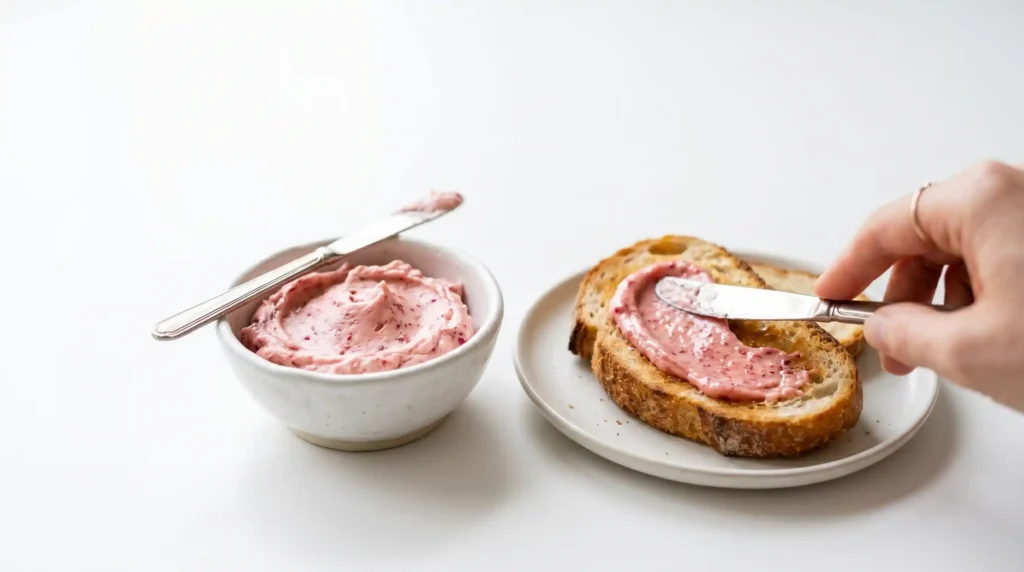
Plain butter is fine. It does its job. Nobody is upset about it. But Strawberry Butter arrives at the breakfast table and immediately makes plain butter feel like it had been underperforming this entire time. Pink from the strawberries, sweet from the honey, slightly salty from the pinch of kosher salt, and endlessly spreadable from the whipping — ten minutes of work and you have a compound butter that genuinely transforms toast, scones, pancakes, and anything else it touches.
I started making this when I had a flat of strawberries at peak ripeness and exactly zero patience for anything more involved than a blender and a mixer. The result was better than I expected — bright, fresh, creamy, and flavourful in a way that commercial strawberry spreads never quite manage because they rely on sugar and concentrate rather than actual fruit. One batch became a standing brunch item that people ask about before they sit down.
Have you ever made a condiment that made the bread beside it irrelevant by comparison? This is that condiment. Let us make it properly.
Why Homemade Strawberry Butter Beats Every Commercial Fruit Spread
Commercial fruit spreads compete with homemade strawberry butter on convenience and shelf life, and they win both. But on flavour, texture, and ingredient quality — they do not come close. A commercial strawberry spread typically contains high-fructose corn syrup or concentrated fruit puree with added pectin to achieve a jam-like consistency. Homemade strawberry butter uses actual fresh strawberries at peak ripeness, which means the strawberry flavour tastes like an actual strawberry rather than a factory approximation.
The texture is the other major distinction. Strawberry butter is a fat-based spread — the butter carries the strawberry flavour through its fat content in a way that water-based jam cannot replicate. Every molecule of strawberry flavour gets distributed through the fat of the butter and coats your palate when eaten, which is why strawberry butter tastes more intensely strawberry than jam despite containing significantly fewer strawberries per serving.
The honey sweetener also makes a meaningful difference compared to refined sugar. Honey adds a floral sweetness and a slightly complex, rounded quality that granulated sugar cannot provide. It also helps the butter spread smoothly at a slightly lower temperature — honey-sweetened butter is more pliable straight from the fridge than sugar-sweetened versions. IMO, the honey is the choice that most elevates homemade strawberry butter above every simple sweet butter recipe I have encountered.
What You Need
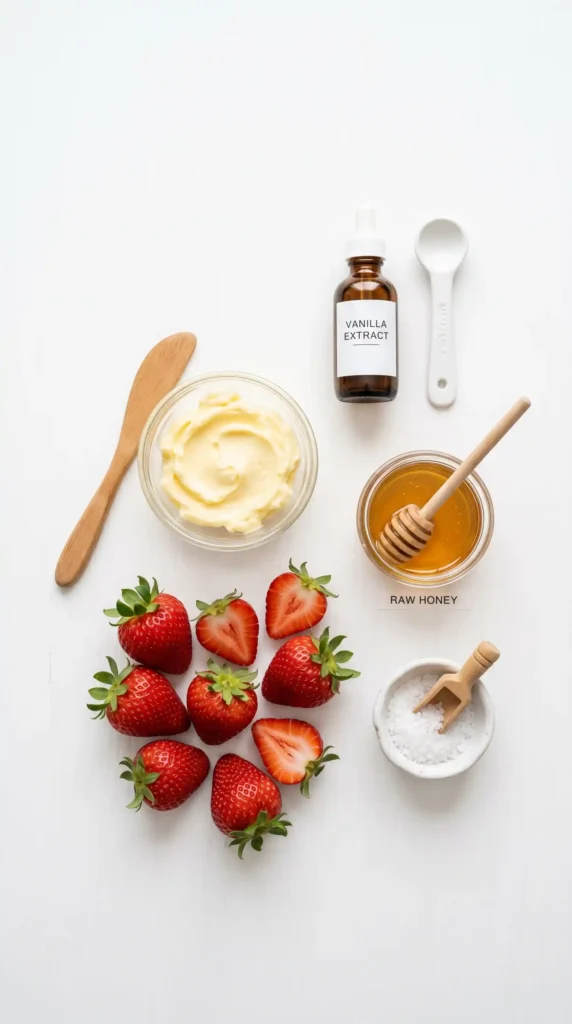
Four ingredients. That is the entire list. The simplicity is genuine — no pectin, no gelatin, no thickeners, no extracts, no food colouring. The pink colour comes from the strawberries. The sweetness comes from the honey. The richness comes from the butter. The depth comes from the salt. Four ingredients, all of them working. Nothing ornamental.
The Full Ingredient List (Makes About 1 Cup)
- 1/2 cup (113g) unsalted butter, softened to room temperature — genuinely room temperature, not slightly cold; the butter should dent easily when pressed and spread without tearing
- 1/2 cup (about 75g) fresh ripe strawberries, hulled — ripe and sweet strawberries are essential; out-of-season pale berries produce a flat, bland flavour that no amount of honey can compensate for
- 1 tablespoon pure honey — acacia or wildflower for a light, clean sweetness; darker honeys like buckwheat are too assertive and overpower the delicate strawberry flavour
- Pinch of kosher salt — about 1/8 teaspoon; this is the element that makes the whole thing taste complete rather than flat and one-dimensionally sweet
Room Temperature Butter Is the Most Important Preparation StepCold butter does not whip — it breaks into chunks rather than incorporating air and achieving the light, fluffy texture that makes strawberry butter spreadable and visually appealing. Pull the butter from the refrigerator at least 45–60 minutes before making this recipe. If you forget, microwave it in 5-second intervals on 30% power, checking and pressing after each interval — you want it soft to the touch but not melted or greasy. Melted butter cannot be whipped and the recipe requires genuine whipping to achieve the right texture. FYI — this preparation step is the difference between strawberry butter and strawberry butter paste, which are not the same experience.
How to Make Strawberry Butter Step by Step
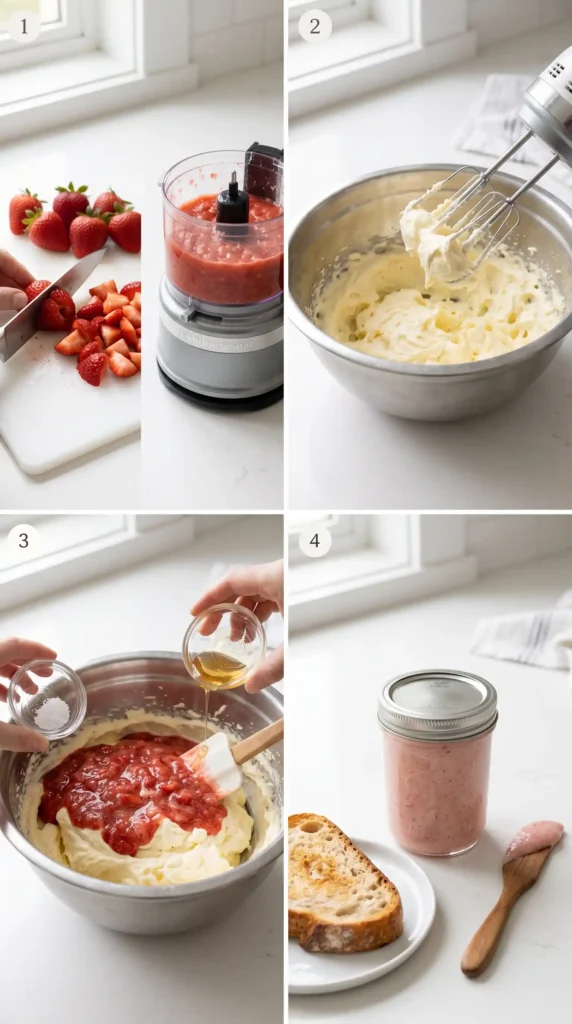
Three steps, all straightforward. The most technical moment is whipping the butter to the right texture before adding the strawberries — properly whipped butter looks noticeably lighter in colour and feels genuinely airy. Every other step is combining and tasting. Ten minutes from cold counter to finished jar.
Step 1: Process the Fresh Strawberries
Hull the strawberries by removing the green tops and any white core from each berry. Place the hulled strawberries in a mini food processor or blender and pulse in short bursts — three or four one-second pulses — until you have a rough, coarse puree with small visible pieces of strawberry throughout. You want texture rather than a completely smooth liquid — visible strawberry pieces in the finished butter look beautiful and provide bursts of intense fruit flavour.
If you do not have a food processor, chop the strawberries as finely as possible with a sharp knife on a cutting board. Very fine knife-chopped strawberries produce a slightly different texture than processed ones — more rustic and less uniform — but taste identical in the finished butter. The important thing is that no large chunks remain that would make the butter uneven or difficult to spread cleanly.
Transfer the processed strawberries to a piece of paper towel or clean kitchen cloth and press lightly to remove a small amount of excess juice — not all of it, just the first bit that would make the finished butter slightly wet. You do not need to squeeze aggressively. One light press removes enough excess moisture to produce butter that holds together rather than looking slightly watery. Set the strawberries aside.
Step 2: Whip the Butter Until Light and Fluffy
Place the room-temperature butter in the bowl of a stand mixer fitted with the paddle or whisk attachment, or in a large bowl if using a hand mixer. Beat on high speed for 2 full minutes until the butter looks noticeably lighter in colour — shifting from bright yellow toward pale cream — and feels airy and fluffy rather than dense. Do not rush this step or shorten the whipping time. Two full minutes of high-speed whipping incorporates enough air into the butter that the finished compound butter will hold its shape in a jar, spread smoothly and evenly from cold or room temperature, and feel lighter in the mouth than unwhipped butter.
Stop the mixer and scrape down the sides of the bowl with a rubber spatula to ensure all the butter has been whipped evenly and no dense unwhipped sections remain at the base of the bowl. Restart the mixer and beat for another 30 seconds. The butter should look almost white and feel like thick, airy cream when you press it against the bowl with the spatula. This is the correct consistency to move forward.
Step 3: Add the Strawberries, Honey, and Salt
Add the processed strawberries, honey, and pinch of kosher salt to the whipped butter all at once. Start the mixer on low speed to prevent the strawberries from flying out of the bowl — liquid additions to whipped butter at high speed create a strawberry mural on your kitchen walls rather than strawberry butter in your bowl. Once the strawberries are partially incorporated, increase the speed to medium and beat for 1 minute until the butter looks uniformly pink throughout with visible strawberry pieces evenly distributed.
Stop the mixer and taste the Strawberry Butter. It should taste sweet from the honey, bright from the fresh strawberry, and slightly salty in a way that highlights both the sweet elements rather than actually tasting salty. If it needs more sweetness, add an additional half teaspoon of honey and beat briefly. If it tastes flat, the pinch of salt was insufficient — add another small pinch and beat again. The ideal strawberry butter tastes like a sweet, creamy, slightly complex strawberry experience rather than just sweet pink butter.
Step 4: Transfer and Store
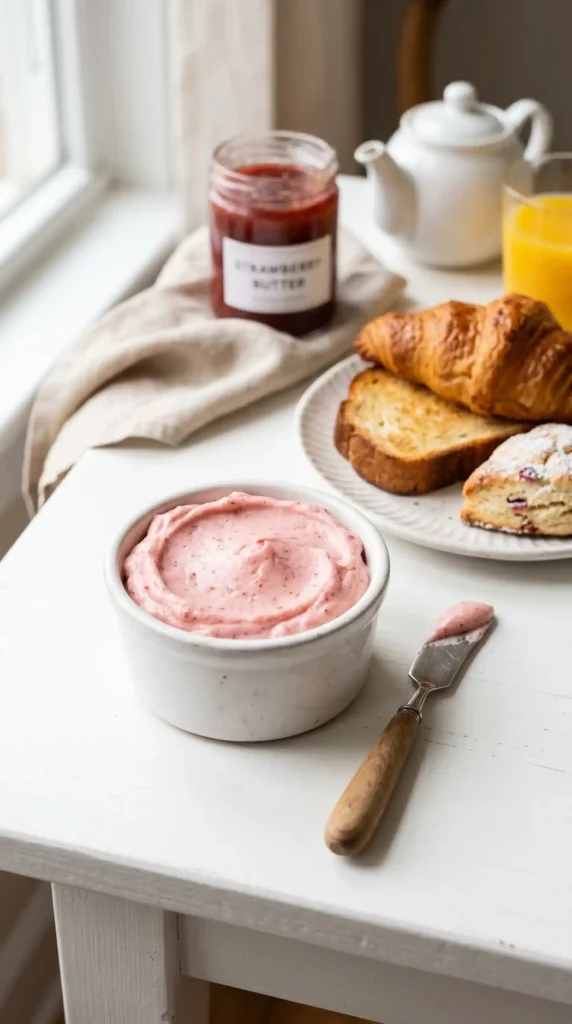
Transfer the finished strawberry butter to a clean glass jar, small ceramic crock, or ramekin. Use a spatula to press it down firmly and eliminate any air pockets. Smooth the surface with the back of a spoon. Press a piece of parchment paper directly against the surface before sealing to prevent oxidation darkening the pink colour during refrigerator storage. Seal and refrigerate. Allow the butter to sit at room temperature for 5–10 minutes before serving so it softens enough to spread easily. :/
Everything Worth Spreading Strawberry Butter On
Warm croissants — the flaky, buttery layers carry the strawberry butter exceptionally well and the heat from the croissant softens the butter immediately on contact.
Freshly toasted sourdough — the slight tang of sourdough and the sweet-tart strawberry butter create the best bread moment available in a ten-second window.
Buttermilk pancakes — spread instead of syrup for a pancake experience that is simultaneously lighter and more interesting than the standard butter-and-maple combination.
Plain scones — particularly at an afternoon tea spread where the pink colour of the strawberry butter contributes to the visual elegance of the whole table.
Cornbread — the sweet-salty-fruity quality of strawberry butter is an extraordinary pairing with savoury, slightly sweet cornbread that makes both taste more complex.
Cake filling — use slightly softened strawberry butter as a filling between vanilla or lemon cake layers for a light, fruity, cream-like filling that suits summer cakes particularly well.
Variations Worth Making
Lemon Strawberry Butter
Add 1 teaspoon of fresh lemon zest to the processed strawberries before combining with the whipped butter. The lemon zest adds a bright citrus note that intensifies the strawberry flavour and adds a floral, summery quality to the finished butter. This version is particularly excellent on blueberry muffins or lemon scones where the citrus element ties all the flavours together. Use only lemon zest — lemon juice adds too much liquid and makes the butter too soft.
Basil Strawberry Butter
Add 4–5 fresh basil leaves, very finely minced, to the strawberries before processing them. The basil adds a herby, slightly peppery note that transforms the butter from purely sweet to genuinely complex — a savoury-sweet combination that pairs beautifully with crusty bread, alongside cheese, or as a finishing element on grilled chicken. This variation surprises people in the best possible way and is especially good when fresh strawberries and fresh basil are both available in the same season.
Honey-Free Strawberry Butter (Lower Sugar Version)
Replace the honey with 1 teaspoon of pure maple syrup or 1 tablespoon of finely grated fresh apple — the apple contributes natural fructose and a mild sweetness without any added sweetener. The apple version produces a less sweet, more fruit-forward butter that suits people who find honey-sweetened compound butters too rich. Increase the pinch of salt very slightly in this version to compensate for the reduced sweetness from the lower-sugar sweetener.
Storage Tips
Store Strawberry Butter sealed in an airtight jar in the refrigerator for up to 7 days. The flavour actually improves on days two and three as the strawberry and honey infuse more deeply into the butter during refrigeration — many people prefer the day-two version to the freshly made one. Remove from the fridge 10 minutes before serving so the butter softens enough to spread without tearing the bread below it.
Strawberry butter freezes well for up to 2 months. Roll it into a log shape in parchment or wax paper, twist the ends, and freeze. Slice off rounds as needed directly from frozen and allow to thaw at room temperature for 5 minutes before spreading. This log-and-freeze approach is the most practical format for making ahead and having strawberry butter available on demand throughout strawberry season and beyond.
Frequently Asked Questions
Can I use frozen strawberries to make strawberry butter?
Yes, but with an important preparation step. Thaw the frozen strawberries completely and drain them in a fine mesh sieve, pressing gently, to remove as much liquid as possible before processing. Frozen strawberries contain significantly more water than fresh — if you do not drain them thoroughly, the excess moisture makes the butter too soft and slightly watery rather than smooth and spreadable. After draining, proceed as directed. The flavour may be slightly less vibrant than fresh peak-season berries since frozen strawberries are often harvested before maximum ripeness.
Can I substitute salted butter for unsalted butter?
Yes, though the final salt level will be harder to control. Salted butter contains a variable amount of salt depending on the brand — typically 1.5–2% by weight. If using salted butter, omit the additional pinch of kosher salt called for in this recipe and taste the finished butter before deciding whether any additional salt is needed. The finished strawberry butter should taste balanced rather than salty — if it tastes at all salty with salted butter, that saltiness is excessive and no additional salt should be added.
Why does my strawberry butter look watery or separated?
Watery or separated strawberry butter almost always results from strawberries with too much surface moisture before they were added to the butter. The butter cannot absorb unlimited liquid — once it has reached its capacity, the excess liquid separates rather than incorporating. To fix this, press the strawberry mixture through a sieve or cheesecloth one more time to remove moisture, then beat the mixture vigorously for another 30–60 seconds to re-emulsify it. For future batches, drain processed strawberries more thoroughly on paper towels before combining with the butter.
Can I use strawberry butter in baking?
Yes. Strawberry butter works in any recipe that calls for softened butter in a role where the strawberry flavour would be welcome — cake frostings where it is used as the fat, muffin batters where it replaces standard butter, shortbread cookies where it adds a subtle fruit note. It melts and behaves identically to plain softened butter in most applications. Be aware that the honey content makes baked goods using strawberry butter brown slightly faster than standard butter versions — reduce the oven temperature by 5°C and watch closely in the final minutes.
Can I make a larger batch of strawberry butter?
Yes — this recipe scales up easily. Double or triple the quantities with the same technique. When making larger batches, ensure your mixing bowl is large enough to accommodate vigorous whipping without butter flying out, and whip the butter for 3–4 minutes rather than 2 to achieve the same airy texture with the greater quantity. Larger batches freeze particularly well in the log format described in the storage section — wrap in parchment, freeze solid, and slice rounds as needed over the following two months.
Final Thoughts
This Strawberry Butter earns its reputation as the most impressive-to-effort-ratio condiment available in a home kitchen. Ten minutes, four ingredients, and a standing mixer or hand mixer produce something that looks like careful artisan preparation and tastes like peak strawberry season every morning you serve it. It transforms breakfast, elevates brunch, and makes any bread basket the most immediately reaching-for element on the table.
Use genuinely ripe, flavourful strawberries. Whip the butter fully before adding anything. Drain the processed strawberries briefly before combining. Taste before serving and adjust salt or honey. These four small decisions produce the absolute best version of a recipe that is already excellent in its simplest form.
Make it this week while strawberries are at their best. Freeze a log for winter mornings when the memory of summer strawberries feels impossibly distant. And accept that once you serve this to anyone at your breakfast table, plain butter will permanently become the also-ran option on your condiment shelf. IMO, that is a very acceptable outcome from ten minutes of work.
Strawberry Butter
Ingredients
Method
- Hull the strawberries and process them in a food processor or blender until roughly pureed with visible pieces.
- Transfer the processed strawberries onto a paper towel or cloth and gently press to remove excess moisture.
- Place room-temperature butter in a mixing bowl and whip on high speed for 2 minutes until light and fluffy.
- Scrape down the sides of the bowl and whip for an additional 30 seconds.
- Add the processed strawberries, honey, and salt to the whipped butter and mix on low speed to combine.
- Once partially mixed, increase speed to medium and beat for 1 minute until uniformly pink.
- Taste and adjust sweetness or salt as needed.
- Transfer strawberry butter into a clean jar and smooth the surface. Store in the refrigerator.
- Let sit at room temperature for 5–10 minutes before serving.