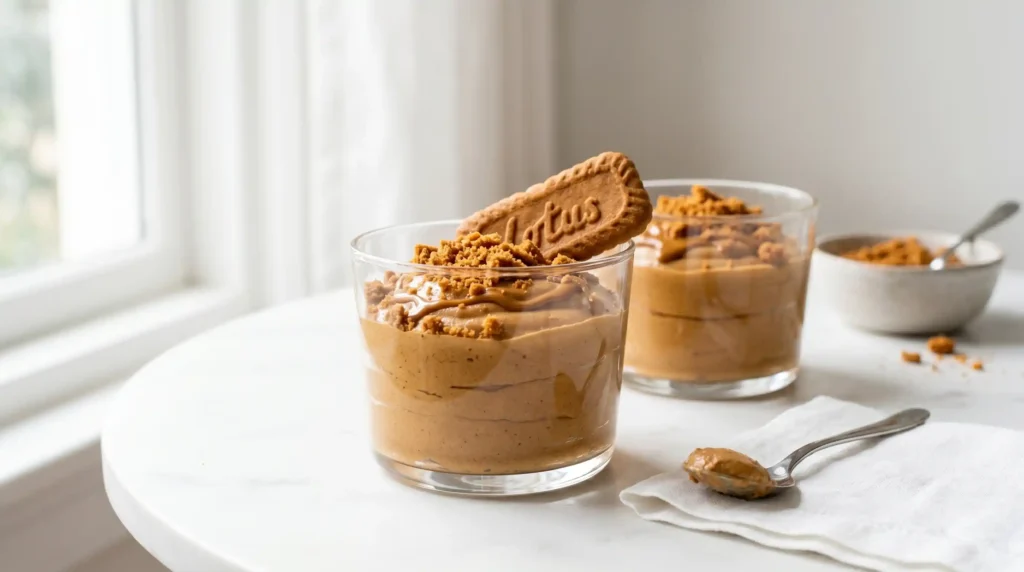
A mousse recipe with two ingredients should not taste this good. That is the honest truth about Biscoff Mousse — it achieves something that should require more complexity, more technique, and more time than it actually does. Biscoff cookie butter folded into cold whipped cream produces a mousse that tastes of caramelised spiced cookie in a cloud-light, silky-smooth dessert form. The ingredient count is insultingly simple. The result is not.
I made this for the first time on an evening when I had approximately nothing in the house, a container of Biscoff spread, and some heavy cream that needed using. I whipped it together as a fast solution, chilled it briefly, and served it in small cups with crushed cookies on top. The response was the kind of enthusiastic silence that tells you something has worked significantly better than the effort level deserved. I have made it deliberately ever since.
Have you ever made something that immediately felt embarrassingly easy to make for how impressive it tasted? This is that recipe. Let us make it properly and discuss every small decision that elevates two ingredients into something genuinely special.
Why Just Two Ingredients Make Such an Extraordinary Mousse
Biscoff spread — the smooth, creamy, jar version of Lotus Biscoff cookies — already contains sugar, fat, and the complex spiced caramel flavours of the baked cookies in a concentrated, smooth form. It tastes like the idealised version of a caramelised biscuit compressed into a spreadable paste. Combined with the fat and structure of whipped cream, it creates a dessert that tastes rich, complex, and distinctly flavoured rather than generically sweet.
Heavy cream, when whipped to stiff peaks, traps air in a stable foam of fat globules. Folding Biscoff spread into this foam distributes the cookie butter flavour throughout millions of tiny air pockets, producing a mousse texture — light and airy from the cream, richly flavoured from the Biscoff. Neither ingredient alone produces this result. Together, they produce something that tastes far more deliberate than two minutes of folding should allow.
The Biscoff spread also plays a structural role that a more liquid flavouring like vanilla extract cannot. The fat and solids in the spread give the mousse body and help it hold its shape during chilling. The result firms to a set, spoonable mousse that holds its form in a cup or glass rather than collapsing into a liquid pool. IMO, this is the most satisfying kitchen chemistry available in a two-ingredient dessert format.
What You Need
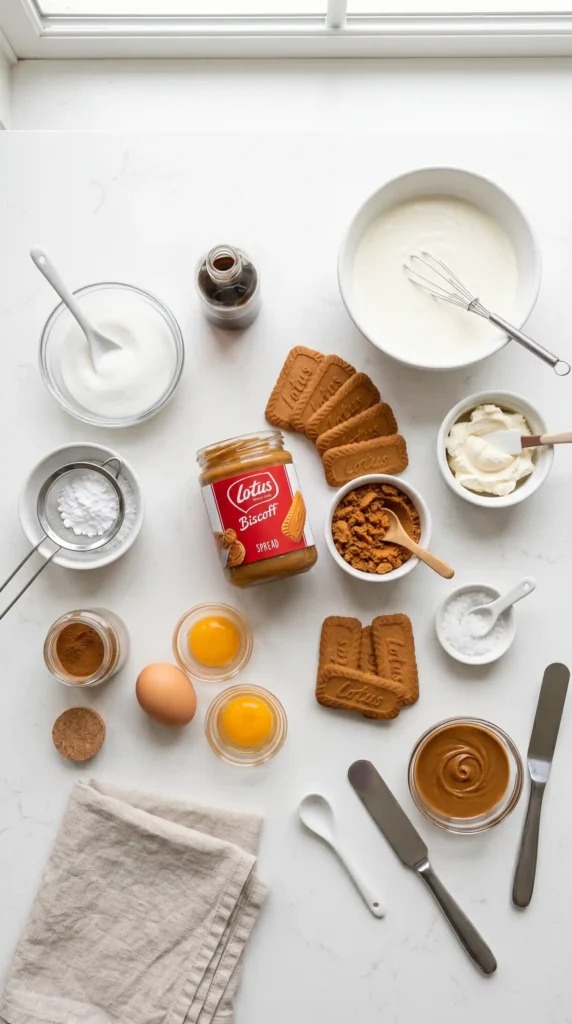
Two ingredients. That is genuinely the entire list for the base mousse. Everything else mentioned below is optional garnish — all worth considering, some worth making a specific grocery trip to obtain, but none of them necessary for an excellent result. The quality of the Biscoff spread matters — use Lotus brand Biscoff spread specifically, both because it is the original and because the flavour depth of the Lotus brand is noticeably superior to generic speculoos spreads.
The Two Essential Ingredients (Serves 4–6)
- 1 cup (260g) smooth Biscoff spread (Lotus brand) — use smooth rather than crunchy for the most even, silk-textured mousse; crunchy spread produces small cookie bits throughout that some people enjoy but that disrupts the uniform silky texture of the smooth version
- 1 and 1/2 cups (360ml) heavy whipping cream — must be cold; warm cream does not whip to stiff peaks reliably; keep it in the refrigerator until the exact moment you start whipping
Optional Garnishes (Choose Your Combination)
- 3–4 Lotus Biscoff cookies, roughly crushed — for a crunchy topping that echoes the spread flavour
- Pinch of flaky sea salt — scattered over the top before serving; the contrast with the sweet mousse is genuinely remarkable
- Additional Biscoff spread, warmed until pourable — drizzled over the set mousse
- A small Biscoff cookie balanced on the rim of each glass for visual presentation
- A dusting of ground cinnamon or cacao powder across the surface
Cold Cream and a Cold Bowl — The Non-Negotiable Whipping ConditionsHeavy cream whips to stiff, stable peaks most efficiently when both the cream and the mixing bowl are very cold. Keep the cream in the refrigerator until the moment you pour it for whipping. Place the mixing bowl and beaters or whisk attachment in the freezer for 10 minutes before whipping. Cold fat molecules hold the air bubbles you whip in more stably — warm cream takes significantly longer to reach stiff peaks and produces a less stable foam that may deflate when the Biscoff is folded in. FYI — this ten-minute preparation step makes a real difference to both the speed and quality of the finished mousse.
How to Make Biscoff Mousse Step by Step
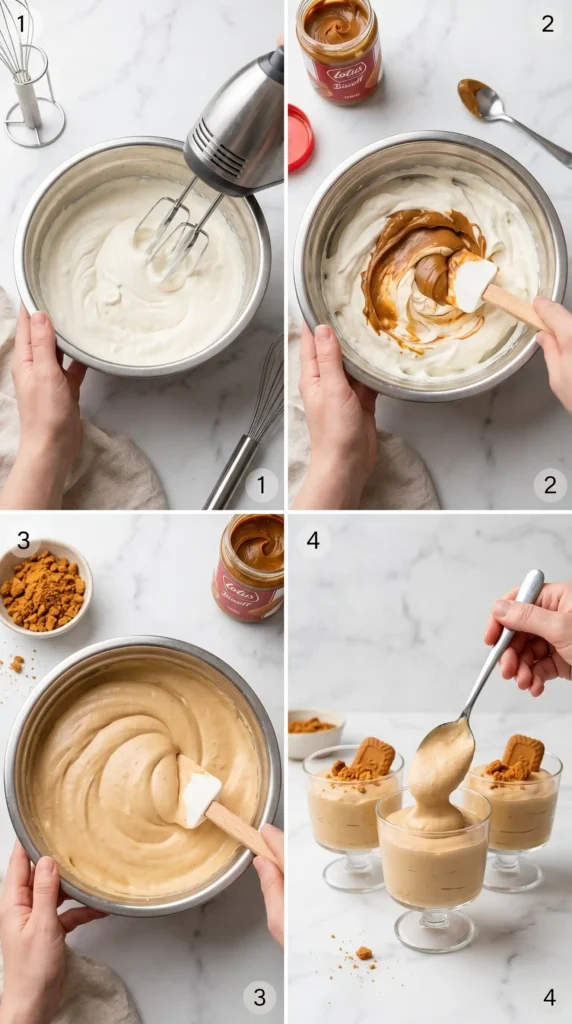
Five steps, all simple. The most technically demanding part is whipping the cream correctly and folding the Biscoff into it without deflating the air structure you just created. Both techniques are learnable in one attempt. Walk through each step with the attention it deserves and your first batch will come out exactly right.
Step 1: Soften the Biscoff Spread
Measure out 1 cup of Biscoff spread into a medium bowl. If the spread came straight from a cupboard or has been stored in a cool environment, it may be quite stiff and firm — this makes it difficult to fold smoothly into whipped cream without crushing the air bubbles. Microwave the Biscoff spread on medium power (50%) for 15–20 seconds and stir briefly.
The correctly softened Biscoff spread should feel slightly warmer than room temperature — softened but not at all liquid or hot. It should look glossy and stir easily with a spoon rather than requiring any force. Spread that is too cold tears through the whipped cream during folding rather than integrating smoothly, producing a mousse with streaks of darker cookie butter rather than a uniformly flavoured result. Spread that is too warm — actually liquid — will deflate the whipped cream completely when folded in. Aim for softened-but-solid.
Step 2: Whip the Heavy Cream to Stiff Peaks
Pour the cold heavy cream into the chilled mixing bowl. Using a hand mixer or a stand mixer fitted with the whisk attachment, begin whipping on medium speed. Start slowly — beginning on high speed immediately can cause cream to splatter. Increase to medium-high after about 20 seconds and whip continuously.
Watch the cream closely as it whips — it passes through several stages: first liquid, then frothy, then soft peaks (cream holds a gentle curve when the beater is lifted), then stiff peaks, which is the target stage. At stiff peaks, the cream looks bright white, holds a defined, upright peak without drooping when the beater is lifted, and feels thick and stable — it will not slump or move when the bowl is tilted. This takes approximately 2–3 minutes on medium-high speed depending on the fat content of the cream and how cold it was.
Stop at stiff peaks — do not whip beyond this point. Over-whipped cream develops a grainy, slightly yellow-tinged texture as the fat begins to separate from the liquid and the structure starts to break down toward butter. Once stiff peaks form, stop the mixer immediately and move directly to folding.
Step 3: Fold the Biscoff Into the Whipped Cream
Add the softened Biscoff spread to the bowl of stiff-peaked whipped cream. Do not stir or beat — folding is the only technique that preserves the air structure. Using a large rubber spatula, cut down through the centre of the bowl, sweep across the bottom, and fold up and over the top in a continuous motion. Rotate the bowl slightly after each fold stroke and repeat.
Add the Biscoff to the cream in two or three additions rather than all at once — adding all the spread at once makes it harder to distribute evenly without over-folding. Fold the first addition in about 6–8 strokes until mostly combined, then add the next portion and fold again. The mousse is ready when it looks uniformly caramel-coloured throughout with no visible white streaks of plain cream or darker streaks of pure Biscoff spread — all one colour, all one texture.
The key warning sign of over-folding is when the mousse begins to look dense and loses its airy, pillowy texture — if you notice the volume decreasing noticeably as you fold, stop immediately even if small streaks remain. A slightly streaky mousse tastes better than a deflated, dense one. The chilling step homogenises the flavour distribution somewhat and reduces the visibility of any remaining streaks after setting.
Step 4: Portion and Chill
Spoon the finished mousse into individual serving vessels — small glass tumblers, wide-mouth glasses, ramekins, or small bowls all work beautifully. Fill each vessel approximately three-quarters full to leave room for toppings and to allow the mousse to look generous rather than sparse. A piping bag fitted with a large round or star tip produces the most visually elegant result — it creates a smooth, swirled surface rather than a textured, spoon-marked one.
Cover each vessel loosely with cling film to prevent the mousse surface from developing a skin or absorbing refrigerator odours during chilling. Place in the refrigerator for a minimum of 1 hour before serving. At 1 hour the mousse has firmed from its just-made soft texture to a set, spoonable consistency. At 2 hours it is at its best — fully firm, silky, and cohesive. Overnight chilling produces the deepest, most developed Biscoff flavour throughout.
Step 5: Garnish and Serve
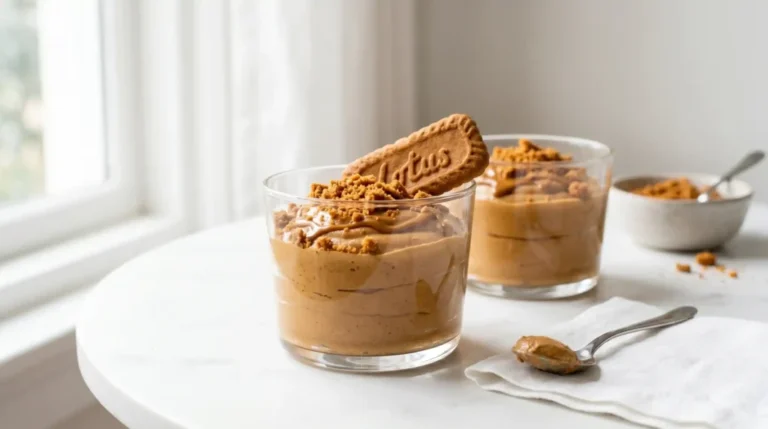
Remove the chilled Biscoff Mousse from the refrigerator just before serving. Scatter a generous pinch of roughly crushed Biscoff cookies over each glass — this is the textural contrast that makes serving in a glass rather than a spoon feel genuinely rewarding. If using, add the sea salt pinch directly over the crushed cookie topping and warm a tablespoon of Biscoff spread briefly and drizzle it over the top in thin, glossy lines.
Variations Worth Making
Chocolate Biscoff Mousse
Add 2 tablespoons of unsweetened cocoa powder to the Biscoff spread before softening — stir it thoroughly into the spread until fully combined. The cocoa deepens the Biscoff flavour and adds a dark chocolate dimension that makes the mousse taste more sophisticated and complex. Top with a small square of dark chocolate balanced on the rim of each glass and a dusting of cacao powder across the surface before serving.
Biscoff Mousse With Cream Cheese
Reduce the Biscoff spread to 3/4 cup and add 115g of softened cream cheese, beaten until smooth. Fold the Biscoff-cream cheese mixture into the whipped cream as directed. The cream cheese version is slightly denser and richer than the pure Biscoff version, with a pleasant tang that cuts through the sweetness and produces a more balanced, cheesecake-adjacent flavour. This version holds its shape more firmly than the two-ingredient base and suits piping particularly well.
Individual Biscoff Mousse Trifles
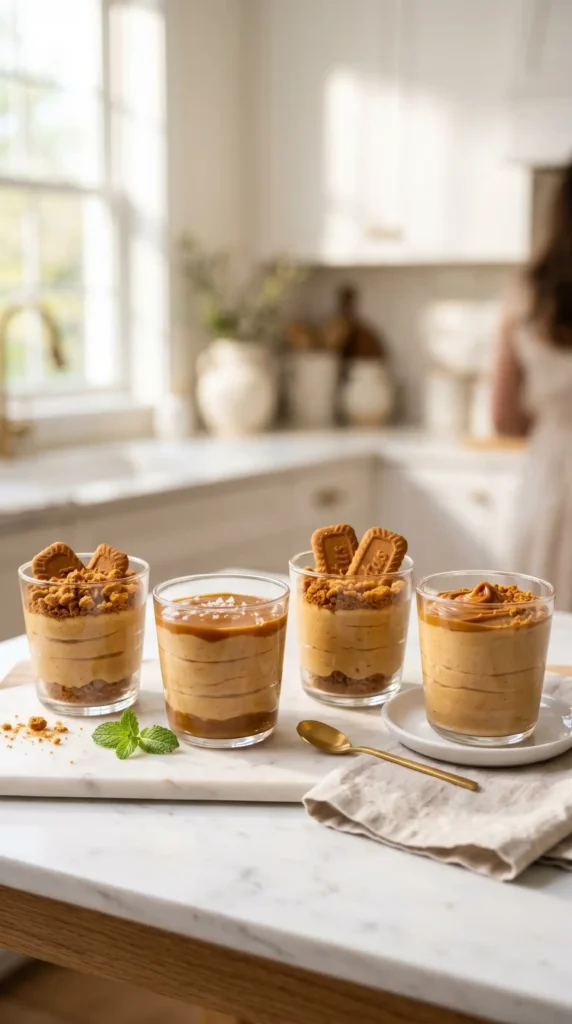
Layer the mousse in glasses with alternating components: a layer of crushed Biscoff cookies, a layer of mousse, a layer of whipped cream, another layer of mousse, and a top layer of crushed cookies with a Biscoff drizzle. The trifle version provides more textural contrast than the straight mousse and serves as a more visually dramatic dinner party dessert. Make each layer distinctly visible through the glass for maximum visual impact.
Storage Tips
Store Biscoff Mousse covered in the refrigerator for up to 3 days. The texture remains excellent throughout this period — the mousse may firm slightly more with extended chilling, which most people prefer to the freshly made consistency. The Biscoff flavour deepens noticeably on day two as the spice compounds from the spread continue to infuse through the cream, making the two-day-old version arguably more flavourful than the just-chilled one.
This mousse does not freeze well — the whipped cream structure breaks down significantly during freezing, producing a separated, grainy result after thawing rather than the smooth, airy texture of the fresh version. Make it within 3 days of serving for the best possible result. Given that it takes ten minutes to produce, making it fresh is genuinely not an inconvenience.
Frequently Asked Questions
Can I use crunchy Biscoff spread instead of smooth?
Yes. Crunchy Biscoff spread contains small cookie pieces throughout the spread that will remain visible as fine texture throughout the mousse after folding. The texture result is slightly less uniform than the smooth version — some people enjoy the intermittent crunch of the cookie pieces, which adds a textural variation to the otherwise silky mousse. If visual uniformity matters for your presentation, use smooth. If you enjoy occasional textural contrast, crunchy Biscoff produces an interesting variation that is worth trying on a second batch after mastering the smooth version.
Can I make Biscoff Mousse without heavy cream?
The mousse requires a fat-rich cream that whips to stiff peaks. Full-fat coconut cream — refrigerated overnight and only the solid cream scooped from the top — whips to stiff peaks and produces a vegan Biscoff mousse with a very slight coconut undertone that complements the Biscoff spice well. Whipping cream or double cream both work identically to heavy cream. Regular full-fat milk does not whip and cannot be substituted. Reduced-fat cream does not whip to the required stiffness and produces an unstable mousse that deflates quickly.
How do I fix a deflated or runny Biscoff Mousse?
A deflated mousse almost always results from over-folding after the whipped cream reached stiff peaks — the folding deflated the air structure progressively. Unfortunately, deflated mousse cannot be re-whipped once the Biscoff is incorporated. If it looks very runny, refrigerate it for 2 hours and reassess — the Biscoff fat may firm sufficiently during chilling to create a usable texture even without the whipped cream structure. For future batches, stop folding the moment no white streaks remain and work with a genuinely cold cream and cold bowl from the start.
Can I add sugar to the mousse?
The Biscoff spread already contains significant sugar — the standard spread is approximately 58% sugar by weight. Adding more sugar to the mousse is very likely to make it cloying rather than balanced. Taste the finished mousse before serving; if it tastes at all flat, a pinch of flaky sea salt is a more effective flavour enhancer than additional sugar. If you genuinely want a sweeter mousse, add 1–2 tablespoons of powdered sugar to the cream before whipping, which incorporates invisibly and provides a subtle additional sweetness without crystalline texture.
Can I use this Biscoff Mousse as a cake filling or frosting?
Yes — the two-ingredient version works as a cake filling but is too soft for exterior frosting unless additional stabilisation is added. For use as filling, apply between layers and refrigerate the assembled cake immediately. For exterior frosting that holds its shape, make the cream cheese version: fold the Biscoff spread with 115g of softened cream cheese and then fold the combined mixture into the stiff whipped cream. The cream cheese version holds its shape much more firmly and can be piped in traditional swirls that stay defined at room temperature for several hours.
Final Thoughts
This Biscoff Mousse earns the title of most impressive-to-effort-ratio dessert available in a two-ingredient format. The spiced caramel complexity of the Biscoff spread, the airy lightness of the whipped cream, and the silky, cloud-like texture they produce together create a dessert that tastes deliberate, refined, and genuinely delicious — from a recipe that takes ten minutes and requires no special skills beyond the ability to fold without over-folding.
Make the cream cold. Make the bowl cold. Fold with restraint. Chill for at least an hour. Add the sea salt. These five decisions produce the absolute best version of something that is already excellent in its simplest form. And then make the cream cheese variation, the chocolate version, and the trifle version — because once you make this, you will want to see how many directions it can go.
Buy the Biscoff spread today. Keep the cream cold in the fridge. Find yourself making this every week for the next several months. And at some point, feel slightly guilty about how easy it is to earn the level of enthusiasm it generates — but not too guilty to stop making it. IMO, there is no need for guilt when the result is this good.
Biscoff Mousse
Ingredients
Method
- Soften the Biscoff spread in a microwave for 15-20 seconds until slightly warm but not liquid.
- Whip the cold heavy cream in a chilled bowl using a mixer until stiff peaks form (2-3 minutes).
- Fold the softened Biscoff spread into the whipped cream in two or three additions without deflating the air structure.
- Portion the mousse into serving vessels, filling them about three-quarters full.
- Cover loosely with cling film and chill in the refrigerator for at least 1 hour.
- Remove from the refrigerator and garnish with crushed cookies and a pinch of sea salt.
- Drizzle warmed Biscoff spread on top and serve immediately.