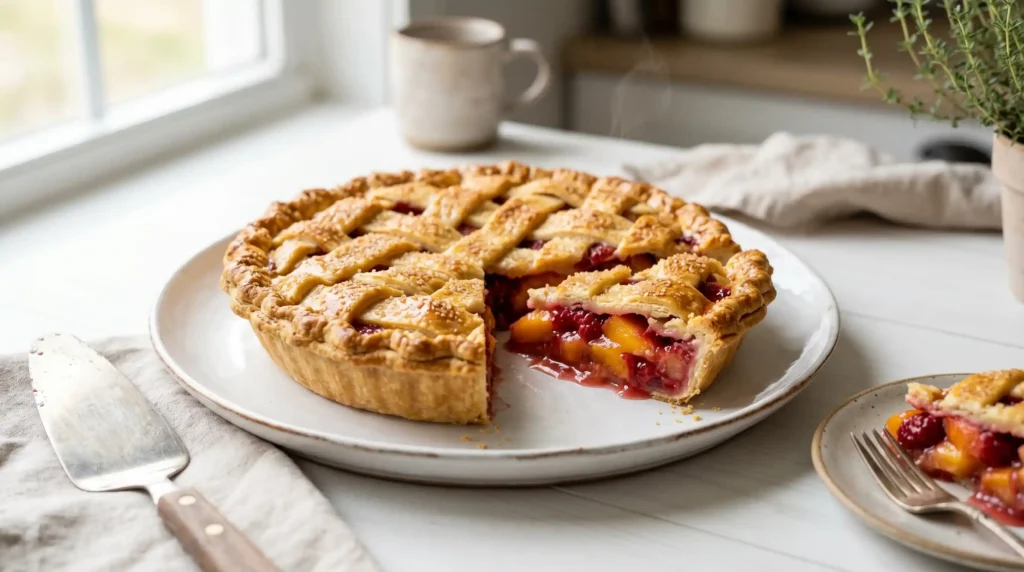
Peach pie alone is a beautiful thing. Raspberry pie alone is a beautiful thing. Put them together in an all-butter double crust and you get something that is genuinely greater than the sum of its parts. The sweet honey-like depth of ripe peaches and the bright, slightly tart punch of raspberries create a filling that keeps every slice interesting from the first forkful to the last crumb.
I made my first Peach Raspberry Pie at the height of peach season when I had too many ripe peaches, a punnet of raspberries that needed using, and a pie crust recipe I trusted. The result made every person in the room ask for a second slice before finishing the first. It has been my signature summer pie ever since and I make no apologies for that level of bias.
Have you ever tasted a pie that genuinely moved you? Not just pleased you — moved you? This can be that pie. Let us build it together, from scratch, properly.
Why Peach and Raspberry Is One of the Great Fruit Pie Combinations
The pairing works because the two fruits complement rather than compete with each other. Ripe peaches taste sweet, slightly floral, and honey-like — they make a beautiful base but can tip into one-dimensional sweetness without contrast. Raspberries supply that contrast. They are tart, bright, and slightly acidic in a way that wakes up the peach flavour and makes the whole filling feel more alive and complex.
The colours work too. Cut into a slice of this pie and you see deep coral-gold peach pieces stained crimson from the raspberry juices — a filling that looks like summer distilled into pastry. Presentation matters in pie, and this combination makes presentation effortless without any extra work on your part.
The cornstarch thickening agent works well with both fruits because it handles the higher moisture content of fresh summer fruit without making the filling gluey or starchy-tasting. The result is a filling that sets to a glossy, jammy consistency that slices cleanly and holds together on the plate rather than flooding across it.
What You Need
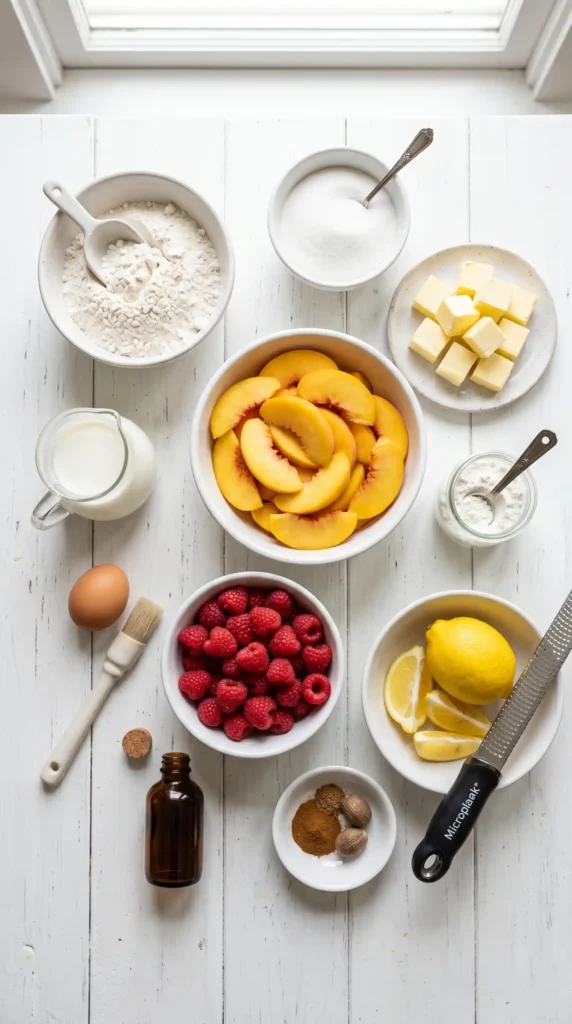
Two components: the all-butter pie crust and the fruit filling. The crust requires cold butter, cold water, and patience with the chilling steps. The filling takes about ten minutes to prepare and goes into the shell raw — it cooks and thickens entirely during baking. Use the ripest, most fragrant peaches you can find. A peach that smells incredible raw will produce a filling that tastes extraordinary baked.
For the All-Butter Double Pie Crust
- 2 and 1/2 cups (315g) all-purpose flour
- 1 tablespoon granulated white sugar
- 1 teaspoon salt
- 1 cup (226g) unsalted butter, very cold, cut into 1cm cubes and frozen for 15 minutes before use
- 6–8 tablespoons (90–120ml) ice-cold water, added one tablespoon at a time
- 1 tablespoon apple cider vinegar (optional — helps keep the crust tender)
For the Peach Raspberry Filling
- 900g (2 lbs / about 6 medium) ripe but firm peaches, peeled, pitted, and sliced 1cm thick
- 300g (about 2 and 1/2 cups) fresh raspberries — or frozen raspberries, do not thaw before using
- 3/4 cup (150g) granulated white sugar — adjust up or down depending on the sweetness of your peaches
- 3 tablespoons (24g) cornstarch
- 1 tablespoon fresh lemon juice
- 1 teaspoon lemon zest
- 1/2 teaspoon ground cinnamon
- 1/4 teaspoon ground nutmeg
- 1/4 teaspoon pure vanilla extract
- Pinch of salt
Now For the Egg Wash and Finish
- 1 large egg beaten with 1 tablespoon whole milk (for the egg wash)
- 1 tablespoon granulated sugar or coarse sugar for sprinkling on the top crust
Always Start With Cold Everything for the CrustThe key to a flaky pie crust is keeping the butter cold throughout the entire process. Cold butter creates steam pockets in the oven as it melts, and those steam pockets produce the flaky, layered texture that defines a great pie crust. Warm butter melts into the flour during mixing and produces a crumbly, dense crust instead. FYI — if your kitchen is warm, refrigerate the mixing bowl for 20 minutes before you start and work quickly once the butter is in.
How to Make Peach Raspberry Pie Step by Step
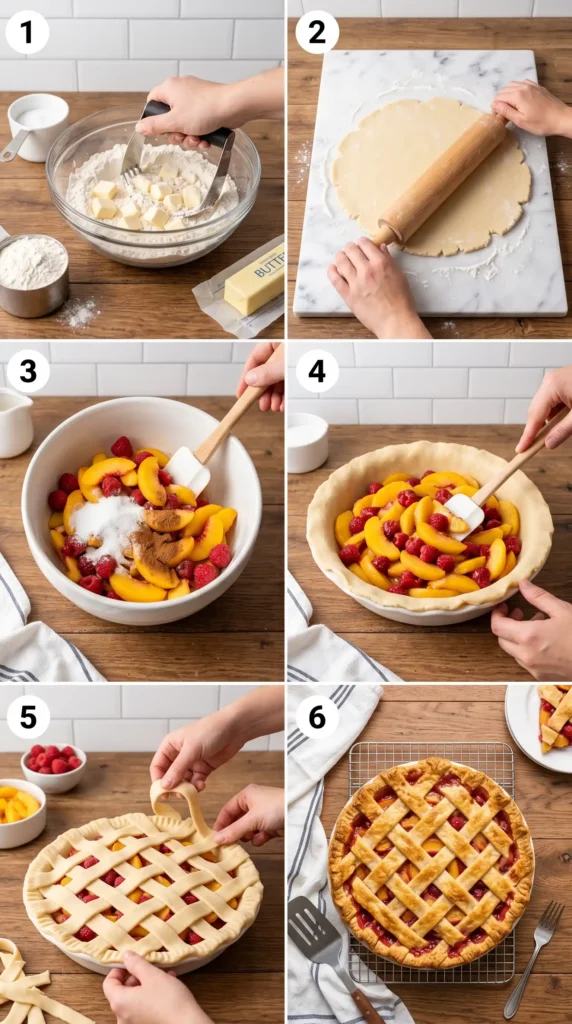
The process divides into three stages: make the crust and chill, prepare the filling, then assemble and bake. The total active time is about 40 minutes — the rest is chilling and baking, both of which require your oven or refrigerator to do the work while you wait. Read through the full process once before starting so the chilling and timing steps make sense in sequence.
Step 1: Make the All-Butter Pie Crust
In a large bowl, whisk together the flour, sugar, and salt until evenly combined. Add the frozen butter cubes to the flour mixture. Using your fingers, a pastry cutter, or a food processor, work the butter into the flour until the mixture resembles coarse breadcrumbs with visible pea-sized and hazelnut-sized pieces of butter scattered throughout. Those larger pieces of butter are not a mistake — they are the architects of your flaky layers.
Add the apple cider vinegar if using, then add the ice-cold water one tablespoon at a time, tossing the mixture gently with a fork after each addition. Stop adding water the moment the dough begins to clump together when pressed between your fingers — you want it to just hold together, not feel wet or sticky. Using too much water develops the gluten in the flour and produces a tough, chewy crust rather than a tender, flaky one.
Turn the dough out onto a clean surface and divide it into two equal portions. Press each portion into a flat disc, wrap in cling film, and refrigerate for a minimum of 60 minutes. This chilling step is non-negotiable. It allows the butter to firm up again after handling, allows the flour to fully hydrate, and relaxes the gluten so the crust rolls out without springing back. Trying to roll out warm pie dough produces a tough, difficult crust that tears and shrinks during baking. :/
Step 2: Prepare the Peach Raspberry Filling
While the dough chills, prepare the filling. Peel the peaches by scoring a shallow X in the bottom of each one, lowering them into boiling water for 30 seconds, then transferring to ice water. The skins slip off easily. Slice the peeled, pitted peaches into 1cm-thick slices and place them in a large bowl.
Add the raspberries to the bowl with the peaches. In a separate small bowl, whisk together the sugar, cornstarch, cinnamon, nutmeg, and salt until evenly combined. Pour this dry mixture over the fruit and add the lemon juice, lemon zest, and vanilla extract. Toss everything together gently — you want the fruit coated without crushing the raspberries completely. Some breakdown is fine and actually desirable since it starts the thickening process in the oven, but you want most of the raspberries to remain recognisably whole in the finished filling.
Set the filling aside at room temperature while you roll the crust. Do not refrigerate it or let it sit for more than 30 minutes — the sugar draws moisture from the fruit during standing time, which is what creates the glossy, jammy quality in the baked filling, but too much pre-bake moisture makes the bottom crust soggy before it has a chance to cook through properly.
Step 3: Roll and Line the Pie Dish
Preheat your oven to 220°C (425°F). Remove one disc of dough from the refrigerator and let it rest at room temperature for 5 minutes — just enough to make it pliable without warming it through. On a lightly floured surface, roll the disc into a circle about 30cm (12 inches) in diameter, rotating the dough a quarter turn after every two or three rolls to ensure it stretches evenly without tearing.
Carefully roll the dough around the rolling pin and unroll it gently over a 23cm (9-inch) deep-dish pie plate. Press it into the base and sides of the plate without stretching it — stretched dough shrinks back during baking. Trim the overhanging edge to about 2cm beyond the rim of the plate using scissors or a sharp knife. Refrigerate the lined plate while you roll the second crust disc.
Step 4: Fill and Top the Pie
Pour the prepared fruit filling into the chilled pastry-lined pie plate, mounding it slightly in the centre — the fruit will settle and shrink during baking so starting with a generous, slightly domed filling prevents the finished pie from looking sunken and hollow. Roll the second pastry disc to the same size as the first.
For a traditional double crust, drape the second disc over the filling and crimp the edges together firmly using your fingers or a fork. Cut five or six 2-inch steam vents in the top crust using a sharp knife — these allow steam to escape from the filling during baking, which prevents the top crust from ballooning up or cracking unpredictably. For a lattice top, cut the second disc into 2cm-wide strips and weave them over the filling in a basket pattern before crimping the edges. The lattice looks spectacular and is considerably easier to achieve than it appears.
Brush the entire top crust generously with the egg wash, covering every visible surface including the crimped edges. The egg wash produces the deep amber-gold colour that makes a homemade pie look genuinely dramatic rather than pale and home-baked in the less complimentary sense. Sprinkle the coarse sugar over the top of the egg-washed crust.
Step 5: Bake the Pie
Place the pie on a rimmed baking sheet to catch any bubbling filling and prevent spills. Start baking at a high temperature (220°C) for 20 minutes to set the crust, then reduce to 175°C and continue baking for 35–40 minutes until the crust is golden and the filling is actively bubbling. If the edges brown too quickly, cover them with foil and continue baking.
Once done, let the Peach Raspberry Pie cool for at least 3–4 hours so the filling can fully set before slicing. To ensure it is properly baked, the filling should bubble in the center or reach about 82°C, which guarantees a thick, stable texture instead of a runny one.
Variations Worth Making
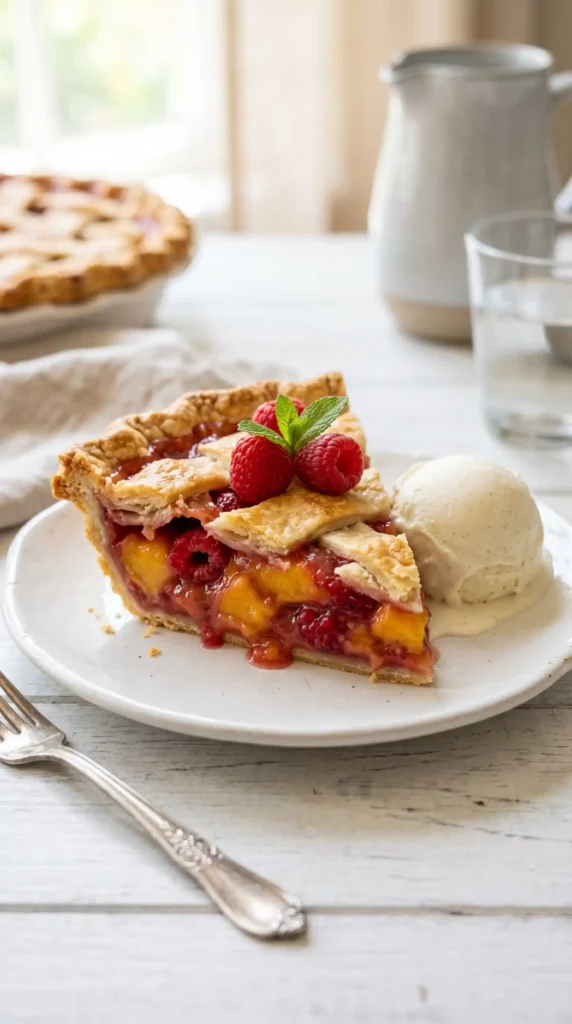
Peach Raspberry Crumble Pie
Use only one pastry disc for the base and replace the top crust with a streusel crumble topping: mix 3/4 cup flour, 1/3 cup oats, 1/2 cup brown sugar, 1/2 cup cold butter cut into cubes, and a teaspoon of cinnamon until crumbly. Scatter generously over the filling and bake as directed. The crumble topping creates a different textural experience — less formal, more rustic, and genuinely delicious with a scoop of vanilla ice cream.
Spiced Peach Raspberry Pie
Add 1/4 teaspoon of ground cardamom and 1/4 teaspoon of ground ginger to the filling spice blend alongside the cinnamon and nutmeg. The cardamom adds a floral, citrusy warmth that makes the raspberry flavour brighter and the peach flavour more exotic. This version feels slightly more sophisticated than the base recipe and works particularly well served warm with a scoop of crème fraîche on top.
Mini Hand Pies
Divide the crust and filling quantities across 12 individual hand pies instead of one large pie. Cut the crust into 15cm circles, fill each with a heaped tablespoon of fruit mixture, fold in half, crimp with a fork, brush with egg wash, and bake at 190°C for 20–22 minutes until golden. These portable individual portions work brilliantly for picnics, packed lunches, and any gathering where a full pie slice is impractical.
Storage and Serving Tips
Store Peach Raspberry Pie loosely covered at room temperature for up to 2 days. Refrigerate for up to 5 days — the crust loses some crispness in the fridge but retains full flavour. Bring refrigerated pie to room temperature for 30 minutes before serving, or warm individual slices in a 160°C (325°F) oven for 8–10 minutes to restore the pastry texture. Serve with vanilla ice cream, whipped cream, or a generous spoon of clotted cream.
The baked pie freezes well for up to 3 months. Wrap the fully cooled pie in cling film then foil and freeze. Thaw overnight in the fridge and warm in a 160°C oven for 20–25 minutes before serving. The filling texture stays consistent after freezing and thawing, though the crust softens slightly — rewarm in the oven to restore as much crispness as possible.
Frequently Asked Questions
Can I use frozen peaches and raspberries?
Yes. Use frozen peaches that have been thawed and drained thoroughly — pat them dry with paper towels to remove as much surface moisture as possible before slicing and adding to the filling. Use frozen raspberries directly from the freezer without thawing — adding them frozen prevents them from releasing all their juice before baking, which keeps the filling from becoming too wet. Increase the cornstarch by an extra tablespoon when using frozen fruit to account for the extra moisture they release during baking.
Why is my pie filling runny even after cooling completely?
A runny filling after full cooling almost always means one of three things: insufficient cornstarch in the filling, the pie did not bake long enough for the filling to reach full bubbling temperature at the centre, or the pie was cut before it cooled fully. The cornstarch must reach 82°C to fully gelatinise and set the filling — if the pie came out of the oven before the centre was actively bubbling, it will not set properly regardless of cooling time.
How do I prevent a soggy bottom crust?
Four strategies combined produce the best result: bake the pie on the lowest oven rack position so the bottom crust gets direct heat; start at a high temperature of 220°C for the first 20 minutes to set the bottom crust quickly; do not let the filling sit in the unbaked crust for more than 15 minutes before it goes in the oven; and use a metal or dark-coloured pie plate rather than glass, which conducts heat more effectively to the base of the crust.
Can I make the pie crust ahead of time?
Yes. The pastry discs keep well wrapped in cling film in the fridge for up to 3 days, or in the freezer for up to 3 months. Thaw frozen dough overnight in the fridge before rolling. You can also roll the bottom crust into the pie plate, cover it loosely with cling film, and refrigerate for up to 24 hours before filling and baking. Making the crust in advance is one of the best ways to break this recipe into manageable stages across two days.
How much sugar should I use if my peaches are very sweet?
Start with 1/2 cup (100g) of sugar rather than the full 3/4 cup if your peaches are very ripe and naturally sweet. Taste a peach slice and adjust based on its sugar level — the filling should taste pleasantly sweet before baking since some sweetness is lost during the cooking process. If your peaches are tart or underripe, use the full 3/4 cup or even a little more. The raspberries add tartness regardless, so lean toward more sweetness if you prefer a balanced rather than tart filling.
Final Thoughts
This Peach Raspberry Pie is the summer baking project worth committing to. The flaky all-butter double crust, the gorgeous deep-coral filling, and the balance of sweet peach against tart raspberry produce something that tastes genuinely impressive and looks like you spent far more time on it than you actually did. That is the hallmark of any recipe worth keeping.
It earns its place as a centrepiece dessert at any summer gathering. It earns compliments that outlast the gathering itself. And it earns the right to be the pie you make every year when peach season arrives and reminds you that some things genuinely cannot be improved upon.
Find your ripest peaches. Make that butter cold. And for the love of everything good, wait the full four hours before you cut into it. The pie will reward your patience magnificently.
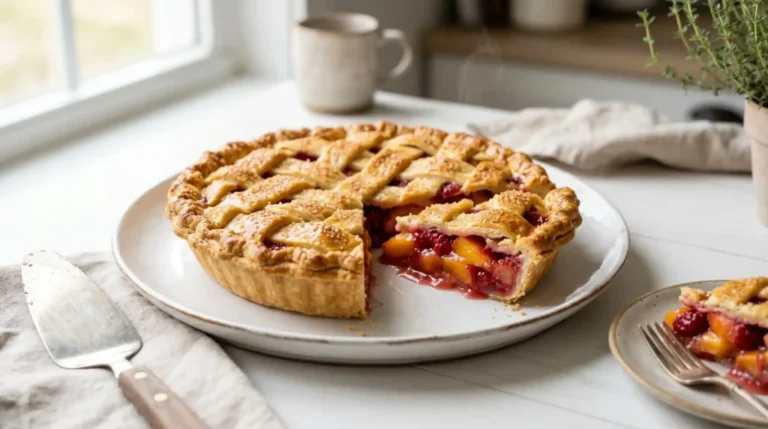
Peach Raspberry Pie
Ingredients
Method
- In a large bowl, whisk together the flour, sugar, and salt until evenly combined.
- Add the frozen butter cubes to the flour mixture and work the butter into the flour until it resembles coarse breadcrumbs.
- Add apple cider vinegar if using, then add ice-cold water one tablespoon at a time, stopping when the dough just holds together.
- Turn the dough out onto a clean surface, divide it into two equal portions, press each into a flat disc, wrap in cling film, and refrigerate for at least 60 minutes.
- Prepare the peaches by blanching them in boiling water for 30 seconds and transferring them to ice water to slip off the skins.
- Slice the peaches and place them in a bowl with raspberries.
- In a separate bowl, whisk together sugar, cornstarch, cinnamon, nutmeg, and salt, then pour it over the fruit along with lemon juice, lemon zest, and vanilla.
- Toss gently, then set the filling aside at room temperature.
- Preheat the oven to 220°C (425°F). Roll the first disc of dough into a circle and line a 9-inch deep-dish pie plate.
- Refrigerate the lined plate while rolling the second disc.
- Pour the filling into the pie crust, mound it slightly in the center, then roll out the second crust and cover the filling.
- Crimp the edges and cut steam vents in the top crust.
- Brush with egg wash and sprinkle sugar on top.
- Place the pie on a rimmed baking sheet and start baking at 220°C for 20 minutes, then reduce to 175°C and bake for another 35–40 minutes.
- Let the pie cool for at least 3–4 hours before slicing.