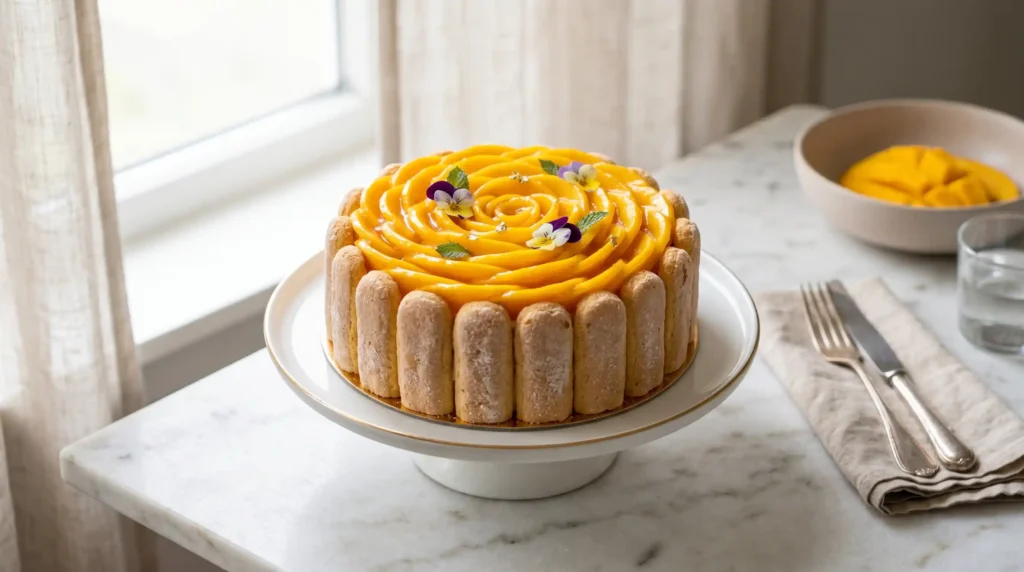
If you have ever wanted to put a dessert on the table and watch everyone’s jaw drop — this is the recipe. A Mango Charlotte looks like something from a French patisserie window. It’s elegant, it’s tropical, and it genuinely does not require baking. Sounds too good to be true, right?
I made my first Mango Charlotte for a birthday dinner three years ago and it has been my go-to impressive dessert ever since. The secret is that it looks far harder than it actually is. Lady fingers, mango mousse, and a good overnight chill do all the work.
Whether you are hosting a dinner party, celebrating a birthday, or just want to do something special on a weekend, this recipe has you fully covered. Let me walk you through every step.
What Is a Mango Charlotte?
A Charlotte is a classic French dessert with a long history. The traditional version uses a mold lined with sponge fingers (ladyfingers or boudoir biscuits) filled with a creamy mousse or Bavarian cream. The Mango Charlotte puts a bright tropical spin on that classic structure.
Instead of the rich, eggy Bavarian cream filling of the original, the mango version uses a light, airy mango mousse made from fresh or canned mango puree, whipped cream, and gelatin. The result is something silky, fruity, and refreshingly not too sweet.
IMO, the Mango Charlotte is the perfect warm-weather celebration dessert. It chills in the fridge, slices cleanly, and the flavor is bright enough to feel like a palate cleanser even while being an indulgent dessert.
Mango Charlotte Ingredients
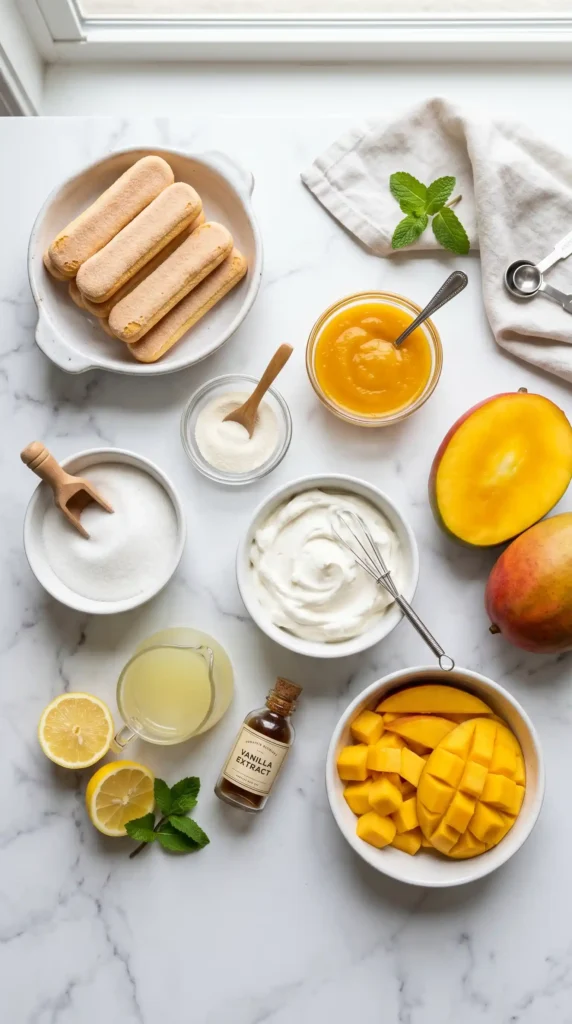
Nothing on this list should send you to a specialty store. Most of it lives in a decent supermarket. The mango is the star, so the better your mango quality, the better your final dessert.
For the Charlotte Base and Shell:
- 24-28 ladyfinger biscuits (savoiardi), roughly 200g
- 1/3 cup mango juice or orange juice (for dipping the ladyfingers)
- 1 tablespoon sugar (to sweeten the dipping juice)
For the Mango Mousse Filling:
- 2 cups fresh mango puree (from about 3 large ripe mangoes, or use canned — see note below)
- 1 cup heavy whipping cream, chilled
- 3 tablespoons powdered sugar
- 2 and 1/2 teaspoons unflavored gelatin powder
- 3 tablespoons cold water (to bloom the gelatin)
- 2 tablespoons fresh lemon or lime juice
- 1/4 teaspoon vanilla extract
For Decoration:
- 1 large ripe mango, peeled and thinly sliced or diced
- 2 tablespoons apricot jam or mango jam, warmed (for glazing — optional but beautiful)
- Fresh mint leaves for garnish (optional)
- A ribbon to tie around the charlotte for presentation (optional but very charming)
FYI — canned mango pulp (like Alphonso variety from Indian brands) works brilliantly here if fresh ripe mangoes are not in season. It’s consistent, sweet, and deeply flavorful. Just skip the added sugar in the mousse since canned pulp is already sweetened.
Equipment You Will Need
- One 7-8 inch springform pan (this is important — a springform makes unmolding clean and easy)
- A hand mixer or stand mixer for whipping the cream
- A blender or food processor for making the mango puree
- A small microwave-safe bowl for blooming the gelatin
- A silicone spatula for folding the mousse
- Plastic wrap or parchment paper for lining
How to Make Mango Charlotte — Step by Step
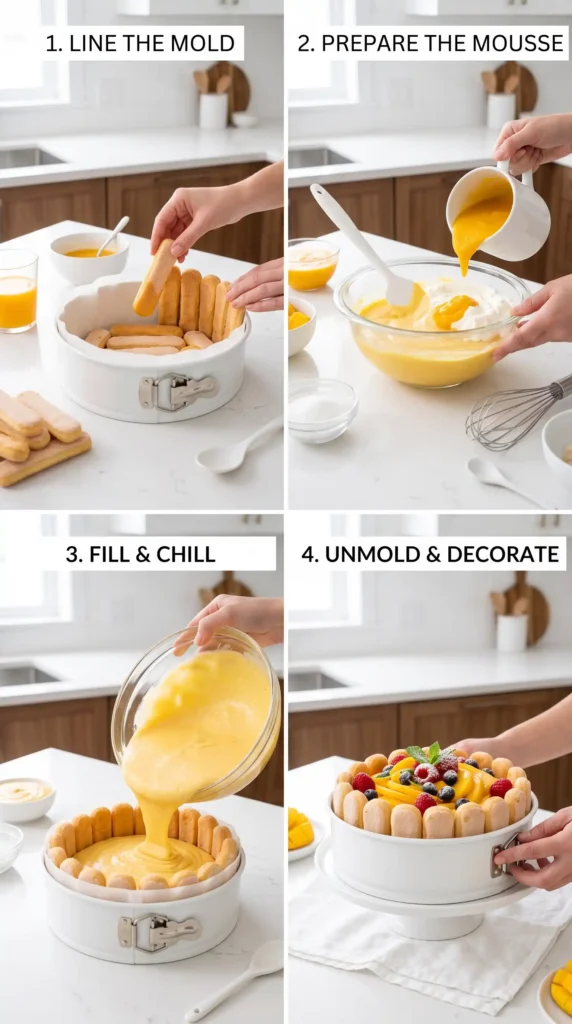
The process breaks into four stages: prepping the pan, making the mango puree, building the mousse, and assembling everything. None of it is complicated. But reading through the full process before you start will save you from surprises halfway through.
Stage 1 – Prepare the Mango Puree
If using fresh mangoes, peel and cut the flesh away from the pit. Roughly chop the mango into chunks. You need around 2 cups of mango flesh to get 2 cups of puree, so start with about 3 large ripe mangoes.
Place the mango chunks into a blender and blend on high until completely smooth. Stop and scrape down the sides if needed. The puree should have no lumps and a completely uniform, silky texture.
Add the 2 tablespoons of lemon or lime juice to the puree and blend for another 10 seconds. The citrus brightens the mango flavor significantly and prevents oxidation. Pour the puree into a bowl and set aside.
Taste the puree. If it is not sweet enough (this depends on your mango variety), add a tablespoon of powdered sugar and stir. You want the puree to taste pleasantly sweet but not overpoweringly so — the mousse will balance it further.
Stage 2 -Bloom and Dissolve the Gelatin
Pour the 3 tablespoons of cold water into a small microwave-safe bowl. Sprinkle the 2 and 1/2 teaspoons of gelatin powder evenly over the surface of the water. Do not stir. Let it sit undisturbed for 5 full minutes. This process is called blooming, and it allows the gelatin granules to fully absorb the water before you dissolve them.
After 5 minutes, the gelatin will look thick, swollen, and slightly translucent. Microwave it on medium power for 15-20 seconds until it melts into a clear liquid. Stir gently. Do not overheat — you want it melted, not boiling. Overheated gelatin loses its setting power.
Let the dissolved gelatin cool for about 2 minutes until it is warm but no longer hot. You need to add it to the mango puree while it is still liquid, but if you add it hot it can affect the texture of your mousse. Warm and fluid is the target.
Pour the warm dissolved gelatin into the mango puree in a slow, thin stream while whisking constantly. Whisk thoroughly so the gelatin distributes evenly throughout the puree. Set the mango-gelatin mixture aside at room temperature while you whip the cream.
Stage 3 -Whip the Cream and Build the Mousse
Pour the 1 cup of chilled heavy whipping cream into a clean, cold mixing bowl. Cold cream whips faster and holds its structure better, so make sure both the bowl and cream are properly chilled — put them in the freezer for 10 minutes beforehand if your kitchen runs warm.
Add the 3 tablespoons of powdered sugar and 1/4 teaspoon of vanilla extract to the cream. Beat on medium speed for about 1 minute until the sugar incorporates, then increase to high speed.
Whip until the cream reaches firm peaks — meaning when you lift the beater, the cream stands up in a defined peak that holds its shape without drooping. This typically takes 2-3 minutes on high speed. Do not overwhip or the cream will turn grainy and buttery.
Add roughly one-third of the whipped cream to the mango-gelatin mixture and whisk it in vigorously. This loosens the mango mixture and makes folding in the remaining cream easier without deflating it.
Add the remaining two-thirds of whipped cream to the mango mixture. Use a large silicone spatula and fold gently — a slow, sweeping motion that cuts through the center and folds from the bottom up. Stop folding the moment you no longer see streaks of white. Over-folding knocks out the air that makes the mousse light.
Stage 4 — Assemble the Charlotte
Line the base of your springform pan with a circle of parchment paper. Lightly grease the sides. This step makes unmolding much cleaner and protects the ladyfingers from sticking.
Mix the 1/3 cup of mango or orange juice with 1 tablespoon of sugar in a shallow bowl. Stir until the sugar dissolves. This is your dipping liquid for the ladyfingers. You want them briefly dipped — moistened on the outside but not completely soaked. A half-second dip on each side is enough.
Stand the dipped ladyfingers upright around the inner edge of the springform pan, sugar side facing outward. They should press snugly against the pan wall and stand tall above the rim slightly. Pack them tightly so there are no large gaps between them. This creates the characteristic ‘fence’ look of a Charlotte.
Arrange a layer of dipped ladyfingers flat across the bottom of the pan to create a solid base. Cut them to fit the gaps if needed. This base holds the mousse and gives each slice a clean bottom when served.
Pour roughly half the mango mousse into the pan over the ladyfinger base. Use a spatula to spread it evenly and tap the pan gently on the counter twice to release any air pockets.
Add another layer of dipped ladyfingers flat across the mousse layer if you have enough. This middle layer adds structure and makes slicing neater. Pour the remaining mousse on top and spread it smooth and level.
Cover the top of the charlotte loosely with plastic wrap — do not press it down onto the surface. Refrigerate for a minimum of 4 hours. Overnight chilling (8-12 hours) is strongly preferred. The gelatin needs time to fully set and the flavors need time to meld.
Stage 5 – Decorate and Serve
- Once fully chilled and set, carefully unclasp and remove the springform ring. Use a thin offset spatula or butter knife to gently ease away any spots where the mousse may have stuck to the sides.
- Arrange your fresh mango slices decoratively on top of the charlotte. You can fan them out in a circular pattern, create a rose shape from thin curled slices, or simply pile them in a casual, abundant mound in the center — all three look beautiful.
- If using the apricot or mango jam glaze, brush a thin layer over the fresh mango pieces on top. Warm the jam until it is just pourable, then apply with a pastry brush for a glossy, professional finish. This also keeps the mango from drying out.
- Add fresh mint leaves as a final garnish and tie a ribbon around the outside of the ladyfinger ring if you want a truly stunning presentation. Slice with a sharp, clean knife and serve cold.
Tips for a Perfect Mango Charlotte
[object Object]Underripe mango makes a pale, acidic mousse. You want deeply orange, fragrant, honey-sweet mango flesh.
[object Object]A quick half-second dip is all they need. Soggy ladyfingers collapse and make the sides of the charlotte fall apart.
[object Object]Hot gelatin added to cold whipped cream causes streaks and uneven setting.
[object Object]A 4-hour minimum chill works, but overnight gives you a fully firm mousse that slices like a dream.
A springform pan is non-negotiable. Trying to unmold a charlotte from a regular cake pan ends in heartbreak every single time.
How to Store Mango Charlotte
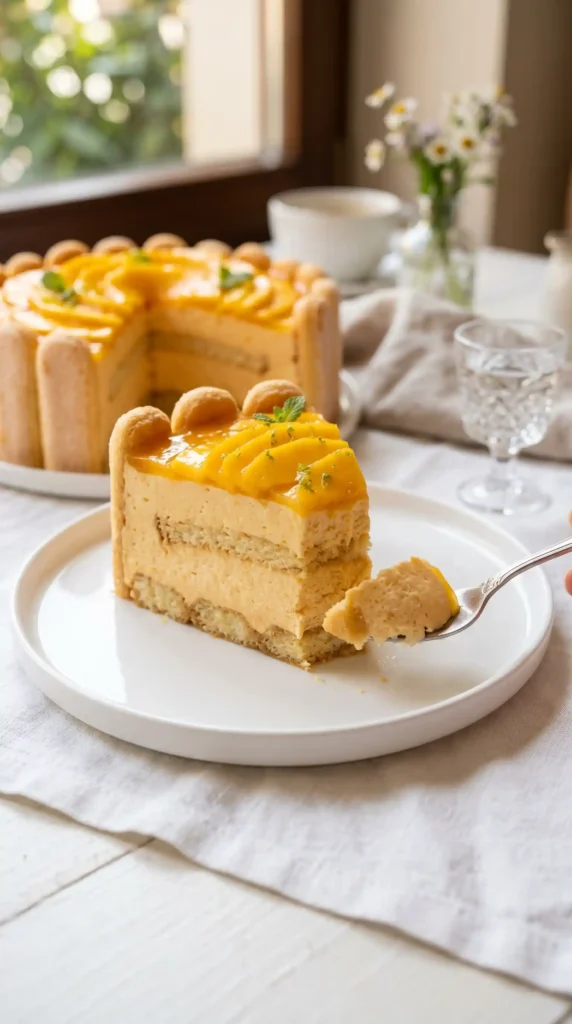
In the fridge: Keep it covered in the refrigerator and serve within 3 days. After that, the ladyfingers start to soften too much and the mousse loses its fresh flavor.
Freezing: You can freeze Mango Charlotte for up to 1 month. Wrap it tightly in cling film and then foil. Thaw overnight in the fridge before serving. The texture changes slightly but remains enjoyable.
Slicing tip: Always use a sharp knife dipped in hot water and wiped dry between cuts. This gives you clean, photogenic slices without dragging through the mousse.
Frequently Asked Questions About Mango Charlotte
Can I make Mango Charlotte without gelatin?
You can try using agar-agar as a substitute, but the texture will be slightly firmer and less silky than gelatin. Use about 1 teaspoon of agar-agar powder in place of the 2.5 teaspoons of gelatin. Dissolve it in the mango puree by heating it briefly rather than blooming it in cold water.
Can I use store-bought whipped cream instead of whipping it myself?
Fresh whipped cream gives you a much more stable, flavorful mousse. Store-bought whipped cream (from a can) deflates quickly and does not hold the structure you need for a mousse that sets properly in the fridge. Spend the 3 minutes whipping it fresh — it makes a real difference.
My mousse did not set properly — what went wrong?
This usually comes down to one of three things: the gelatin was overheated and lost its setting power, the gelatin was not fully dissolved before adding to the puree, or the charlotte did not chill long enough. Make sure your gelatin is properly bloomed and fully melted, and always chill for at least 4 hours.
Can I make Mango Charlotte the day before serving?
Yes, and you absolutely should. Making it the day before is actually the ideal approach. Overnight chilling gives the mousse maximum firmness, the flavors fully develop, and you save yourself all the work on the day you plan to serve it. Just add the fresh mango topping on the day of serving.
Can I use other fruits instead of mango?
Absolutely. The same base recipe works beautifully with strawberry, raspberry, passion fruit, or peach puree. Just adjust the sweetness based on how tart your chosen fruit is. Passion fruit mixed 50/50 with mango is a particularly spectacular combination worth trying.
Final Thoughts on Mango Charlotte
A Mango Charlotte is the kind of dessert that makes people think you spent all day in the kitchen — when really you spent about 40 minutes and let the fridge do the hard part. That is exactly the kind of recipe worth having in your arsenal.
Ripe mangoes, properly whipped cream, gelatin that fully sets, and a generous overnight chill: those four things are the difference between a good Charlotte and a great one. Nail those and everything else falls into place. Make it for your next dinner party, your next birthday, or honestly just because it is the weekend and you deserve something beautiful. Once you see everyone’s faces when you bring it to the table, you will understand why this became my signature dessert.
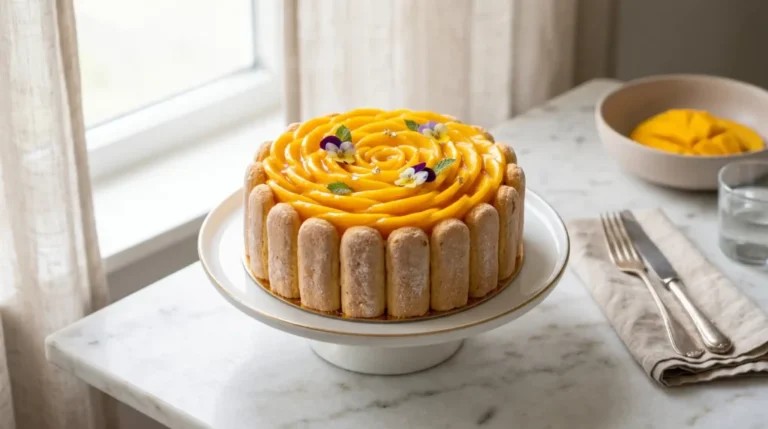
Mango Charlotte
Ingredients
Method
- Prepare the mango puree by peeling and chopping the mangoes, then blending into a smooth puree. Add lemon or lime juice and blend for an additional 10 seconds.
- Bloom the gelatin by sprinkling it over cold water and letting it sit for 5 minutes, then microwave until melted, about 15-20 seconds.
- In a clean bowl, whip the chilled heavy cream with powdered sugar and vanilla extract until stiff peaks form.
- Line the bottom of a springform pan with parchment paper and grease the sides.
- Dip the ladyfingers in the mango or orange juice mixture and arrange them around the sides and bottom of the pan.
- Fold the whipped cream into the mango-gelatin mixture gently and pour half into the prepared pan.
- Add another layer of dipped ladyfingers, then top with the remaining mousse. Smooth the top and cover with plastic wrap.
- Refrigerate for at least 4 hours, preferably overnight to let it set.
- Unmold the charlotte and arrange fresh mango on top. Optionally glaze with warmed jam and garnish with mint leaves.
- Slice with a hot, dry knife and serve cold.