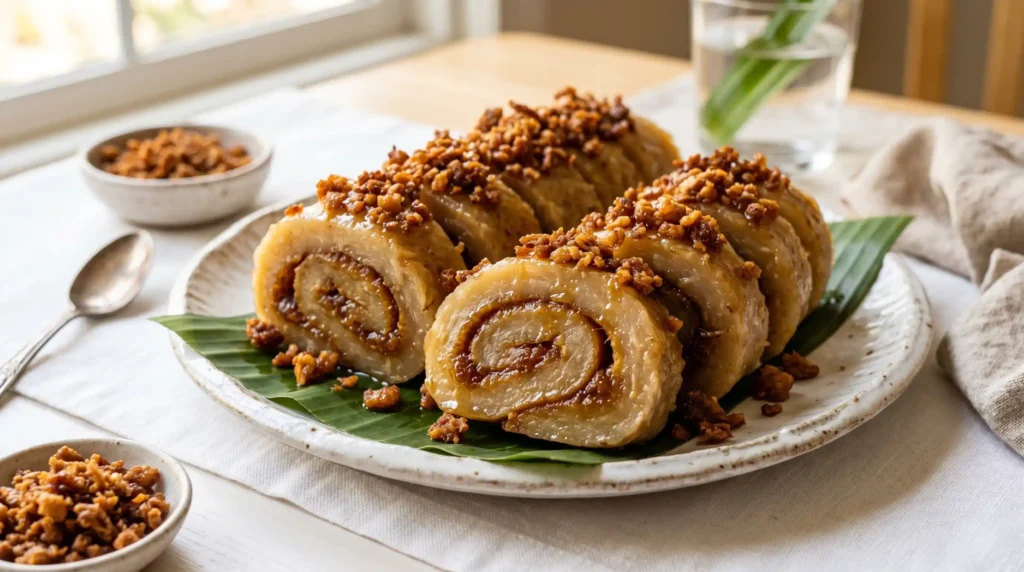
Filipino kakanin occupies a category of desserts that most people who have tasted them remember for years. Creamy Cassava Roll With Latik Filling is among the most memorable — a soft, dense cassava base wrapped around a sweet, slightly salty coconut latik filling, topped with crispy golden coconut curds and brushed with butter. It tastes unmistakably Filipino, deeply nostalgic for anyone who grew up eating it, and genuinely surprising and wonderful for anyone encountering it for the first time.
I made this for the first time with a friend who grew up in the Philippines and wanted to teach me kakanin properly. The kitchen smelled extraordinary from the moment the coconut milk hit the pan — that deep, caramelising coconut aroma that signals something genuinely good in progress. The finished rolls tasted even better than the process smelled, which I did not think was possible. I have made them regularly since and they earn the same reaction every time.
Have you ever made a dessert that felt like learning a whole new category of cooking? This is that experience. Let us build these rolls properly, step by step.
What Is Latik and Why Does It Make Everything Better?
Latik is a traditional Filipino ingredient made by cooking coconut milk or coconut cream until the water evaporates and the coconut oil separates — at this point, the remaining coconut solids continue cooking in the released oil until they turn golden, crispy, and deeply caramelised. The result is simultaneously a flavourful cooking oil (the separated coconut oil) and crispy coconut curds that taste of toasted, slightly caramelised coconut.
In this recipe, latik appears in two forms. The filling uses a sweet, syrupy version made from coconut milk cooked with sugar — similar in concept to a soft coconut caramel — that gets rolled into the centre of the cassava dough. The topping uses the crispy curd version — properly cooked latik curds that scatter across the baked rolls and provide a textural and flavour contrast to the soft interior.
The coconut oil produced during making the curd latik is also used to brush the finished rolls — it adds richness and coconut fragrance that no other oil replicates. FYI — making latik from scratch takes about 20 minutes of active stirring and produces something that elevates every dish it touches. It is genuinely worth the time and the recipe below walks through it in detail.
What You Need–Creamy Cassava Roll With Latik Filling
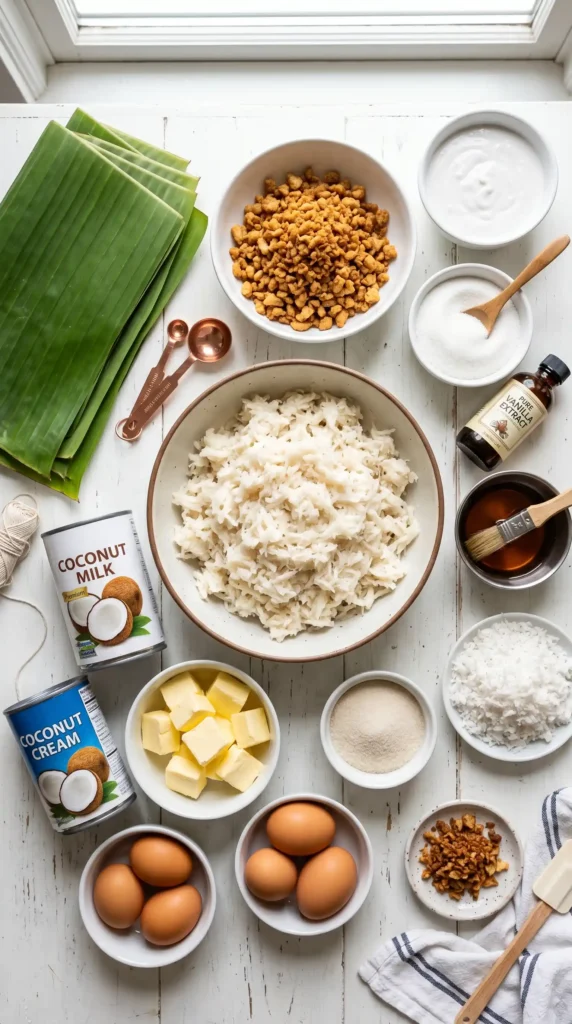
Three components: the cassava dough, the sweet latik filling, and the crispy latik curd topping. The cassava is available in most Asian grocery stores in grated frozen form — thaw and squeeze dry before using. The coconut milk and condensed milk are standard pantry items. Banana leaves, traditionally used for the rolling and baking surface, add a subtle herbal fragrance to the finished rolls and are widely available at Asian grocery stores.
For the Cassava Dough
- 4 cups (about 600g) freshly grated or thawed frozen grated cassava, squeezed very dry
- 1 can (400ml) full-fat coconut milk
- 1 can (400ml) sweetened condensed milk
- 2 large eggs, lightly beaten
- 4 tablespoons (57g) unsalted butter, melted
- 1 teaspoon vanilla extract
- 1/4 teaspoon salt
For the Sweet Latik Filling
- 1 can (400ml) full-fat coconut milk
- 1/2 cup (100g) granulated white sugar
- 1/4 teaspoon salt
Now For the Crispy Latik Curd Topping
- 2 cans (800ml total) full-fat coconut cream (coconut cream produces more curds than coconut milk)
For Assembly
- Banana leaves, wilted over low heat until pliable, wiped clean (or substitute parchment paper)
- Reserved coconut oil from making the latik curds (for brushing the finished rolls)
Squeezing the Cassava Dry Is the Most Important Step in This Entire RecipeFreshly grated or thawed frozen cassava contains a significant amount of water. If you mix it into the dough without squeezing it thoroughly, the resulting dough will be too wet to hold together on the banana leaf, will bake into a gummy rather than firm texture, and will not produce the clean, sliceable roll you are aiming for. Place the grated cassava in a clean kitchen towel or cheesecloth and twist firmly over the sink, squeezing in batches until the cassava feels almost dry to the touch. This removes the excess moisture that prevents the dough from setting properly during baking.
How to Make Creamy Cassava Roll With Latik Filling Step by Step
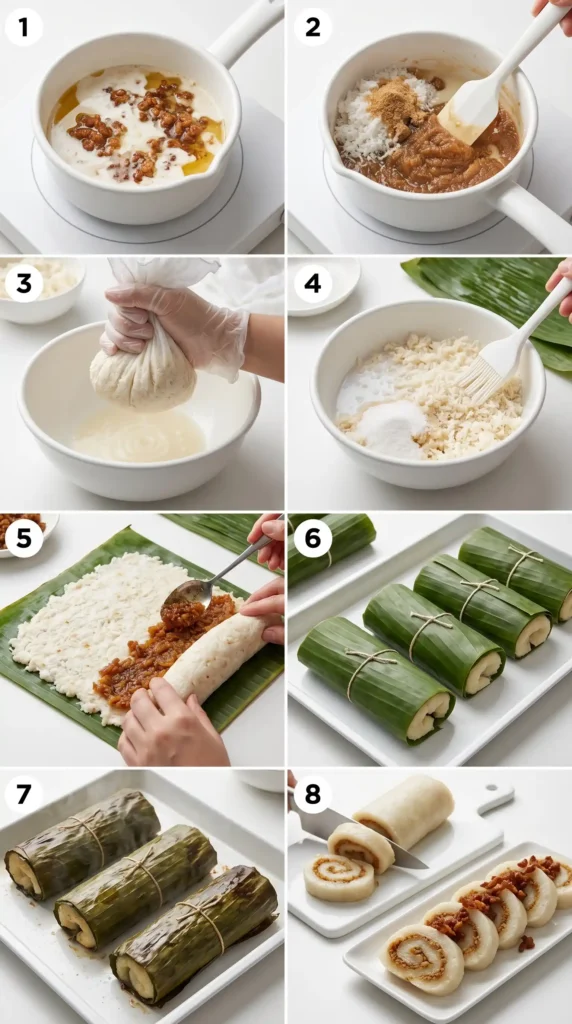
The recipe runs in three stages that can overlap: make the latik curd and filling simultaneously, mix the cassava dough, then assemble and bake. The latik stages require attention and stirring — set timers and stay at the stove. The cassava dough is straightforward by comparison. Read through everything once before starting and the 75-minute process will feel logical and manageable.
Step 1: Make the Crispy Latik Curds
Pour the 2 cans of coconut cream into a large, wide pan or wok over medium heat. Stir occasionally as the coconut cream begins to heat and the water starts evaporating. After about 10–15 minutes of heating and occasional stirring, you will notice the coconut cream separating — a clear oil will rise to the surface and the solids will begin to form visible curds in the pan. The mixture will bubble actively during this stage.
Continue cooking and now stir more frequently as the curds form and begin to cook in the released coconut oil. The curds progress through stages: white and soft, then very pale golden, then golden-brown and fragrant. Stir constantly once they reach the golden-pale stage to prevent burning — the curds go from golden to burnt very quickly and burnt latik is acrid rather than sweet and caramelised. Remove the pan from the heat when the curds look deep golden-amber and crispy.
Drain the curds from the coconut oil using a fine mesh sieve over a bowl, reserving both the crispy curds and the clear golden coconut oil separately. The curds will firm up further as they cool. The coconut oil goes into a small bowl for brushing the finished rolls. Set both aside and allow to cool while you proceed with the remaining stages.
Step 2: Make the Sweet Latik Filling
While the latik curds cool, combine the full can of coconut milk, granulated sugar, and salt in a medium saucepan over medium heat. Stir to dissolve the sugar and bring the mixture to a gentle simmer. Cook, stirring frequently, for about 15–20 minutes until the mixture thickens significantly — it should coat the back of a spoon and leave a clear trail when a finger is drawn through it. It will look like a thick, creamy, slightly golden sauce rather than the runny consistency of plain coconut milk.
Remove from the heat and allow to cool to room temperature before using — a warm filling will make the cassava dough too soft and difficult to roll. The filling should be spreadable but hold its shape on the dough rather than running immediately when spread. If it looks too thin after cooling, return it to low heat for another 5 minutes and stir until it reduces further.
Step 3: Prepare the Banana Leaves
Pass each banana leaf over a low gas flame or hold it briefly over an electric burner on low heat, moving it constantly, until it wilts slightly and becomes flexible. Wilted banana leaves fold and roll without tearing — stiff, unwilted leaves crack and split when you try to roll the cassava inside them, releasing all the filling and collapsing the roll before it reaches the oven. Wipe each wilted leaf with a clean damp cloth and cut into rectangles approximately 30x25cm — these become the rolling mats for each cassava roll.
Step 4: Mix the Cassava Dough
In a large mixing bowl, combine the thoroughly squeezed-dry grated cassava, full-fat coconut milk, sweetened condensed milk, lightly beaten eggs, melted butter, vanilla extract, and salt. Mix thoroughly with a wooden spoon or spatula until all ingredients are fully incorporated and the mixture looks uniform — a thick, dense, slightly sticky dough that holds its shape when pressed. Taste it — the raw dough should taste sweet, milky, and richly coconut-forward. Adjust vanilla if desired.
Step 5: Assemble the Rolls
Preheat your oven to 175°C (350°F). Lay one prepared banana leaf rectangle on your work surface, shiny side up. Spoon approximately 2/3 cup of the cassava dough onto the centre of the leaf and spread it into a thin, even rectangle — about 20x15cm and 8–10mm thick. Press firmly and evenly with wet fingertips to create a flat, uniform layer with no gaps or thin spots that would allow the filling to escape during rolling.
Spoon 2–3 tablespoons of the cooled sweet latik filling along the centre of the cassava rectangle in a thin, even line running the full length of the dough. The filling should be generous but not overloaded — too much filling prevents the roll from sealing properly and it will burst open during baking.
Using the banana leaf as a guide, lift one long edge of the dough and fold it over the filling toward the opposite edge — essentially using the leaf to help you roll the cassava like a sushi roll or Swiss roll. Press the seam firmly closed with your fingers. Roll the banana leaf around the outside of the sealed cassava roll and fold the ends of the leaf underneath to seal. Repeat this process with the remaining dough and filling to produce all 10–12 rolls.
Step 6: Bake the Rolls
Arrange the wrapped rolls seam-side-down in a single layer in a baking dish or on a baking sheet. Bake at 175°C for 40–45 minutes until the cassava dough is cooked through and set — it should feel firm and spring back when pressed through the banana leaf rather than feeling soft or yielding. Remove from the oven and allow to cool for 10 minutes before unwrapping.
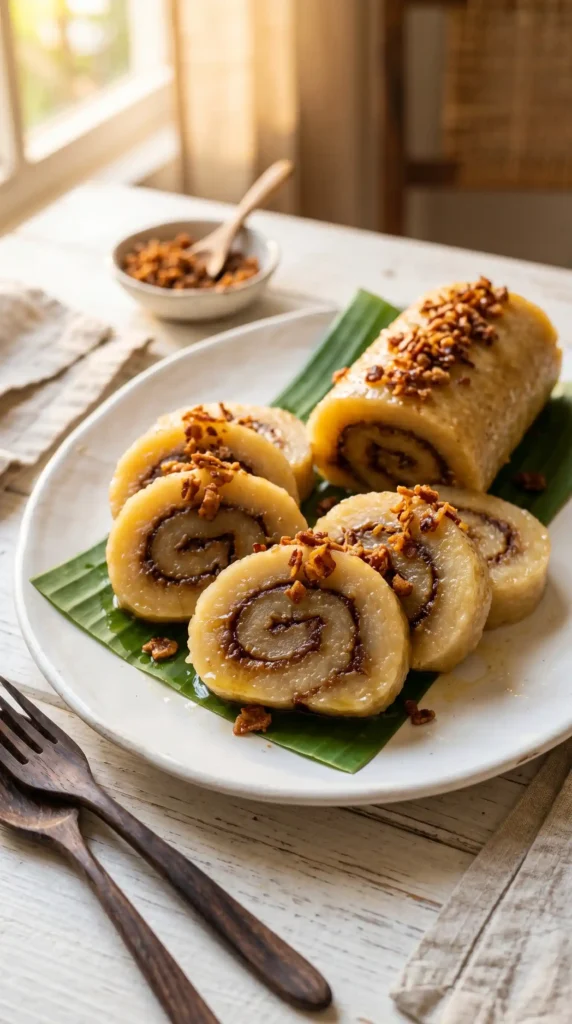
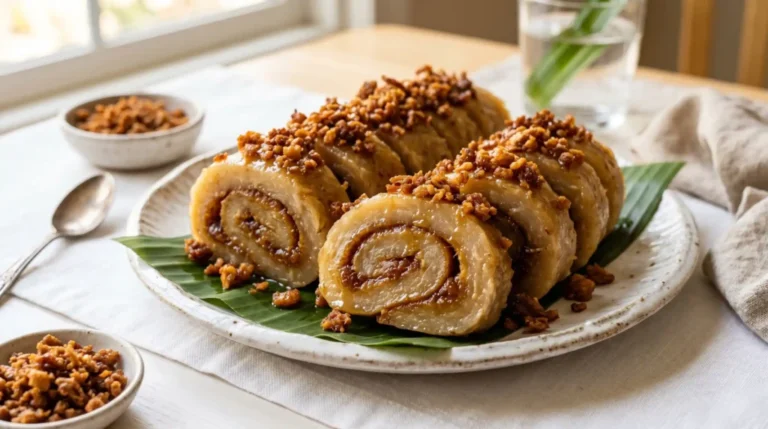
Carefully unwrap each roll by peeling the banana leaf away. The finished Creamy Cassava Roll With Latik Filling should hold its round shape cleanly, reveal a visible swirl of sweet filling in cross-section when cut, and have a slightly golden surface from baking. Brush each warm roll generously with the reserved coconut oil from making the latik curds — the oil soaks into the warm cassava surface and adds richness and fragrance.
Step 7: Top and Serve
Scatter the crispy golden latik curds generously over the coconut-oil-brushed rolls while they are still warm. The curds adhere to the oily surface and stay in place during serving. Slice each roll into rounds 2–3cm thick to reveal the cross-section swirl of filling — this presentation makes the effort visible in the most beautiful way. Serve warm or at room temperature.
Banana Leaf Substitution — Parchment Paper WorksIf banana leaves are not available, use heavy-duty aluminium foil or parchment paper as a rolling and wrapping substitute. The foil provides more rigidity during rolling and baking, which makes the technique slightly easier for beginners. The finished rolls will not have the subtle herbal fragrance that banana leaves contribute, but the flavour of the cassava and latik is so prominent that the difference is minimal. Cut parchment into the same size as the banana leaf rectangles and use the same rolling technique.
Variations Worth Making-Creamy Cassava Roll With Latik Filling
Ube Cassava Roll
Add 2 tablespoons of ube halaya (purple yam jam) to the cassava dough and reduce the condensed milk by the same amount to maintain the right consistency. The ube turns the dough a vivid purple and adds a distinctly Filipino sweet potato flavour that pairs extraordinarily well with the coconut latik filling. Top the finished rolls with ube-coloured latik curds by mixing a small amount of ube powder into the curd topping.
Pandan Cassava Roll
Add 1 teaspoon of pandan extract or 2 tablespoons of fresh pandan juice to the cassava dough. Pandan — the fragrant Southeast Asian herb sometimes called the vanilla of Asia — adds a distinctive green colour and a sweet, slightly floral fragrance that transforms the rolls dramatically. The pandan fragrance and the coconut latik complement each other in a combination that is deeply traditional and beloved across Filipino and Southeast Asian dessert culture.
Cheese-Stuffed Cassava Roll
Replace the sweet latik filling with a mixture of grated quick-melt cheese (like Eden or Velveeta) blended with 2 tablespoons of condensed milk and a pinch of salt. The cheese melts into the cassava during baking and creates a salty-sweet contrast that is extraordinarily popular in Filipino desserts. Top with both crispy latik curds and additional grated cheese scattered over the warm rolls after baking.
Storage and Serving Tips
Store Creamy Cassava Roll With Latik Filling at room temperature wrapped in banana leaf or cling film for up to 1 day. Refrigerate for up to 3 days — the cassava dough firms significantly in the fridge, producing a denser texture than the fresh version. Reheat refrigerated rolls in a steamer for 5 minutes or in a microwave for 30–45 seconds to restore the soft, slightly yielding texture. Re-brush with coconut oil after reheating and add fresh latik curds.
These rolls do not freeze well — the cassava texture becomes grainy and crumbly after thawing. Make them fresh on the day of serving for the best possible result. The latik curds can be made up to 3 days in advance and stored in an airtight container at room temperature — they stay crispy for this duration and are ready to sprinkle over freshly baked rolls when needed.
Frequently Asked Questions
Can I use frozen grated cassava instead of fresh?
Yes — frozen grated cassava works very well and is often more convenient than fresh. Thaw it completely before using, then squeeze it extremely dry in a kitchen towel — frozen cassava typically releases even more water during thawing than fresh, so thorough squeezing is especially important. The flavour difference between fresh and frozen is minimal in a dessert where condensed milk, coconut milk, and vanilla are the dominant flavour notes. Most Asian grocery stores carry frozen grated cassava in one-kilogram bags.
What is the difference between latik curds and latik sauce?
Latik curds are the crispy golden solids produced when coconut cream is cooked until all water evaporates and the remaining solids fry in the released coconut oil. They taste of toasted, caramelised coconut and provide crunch. Latik sauce — the filling used in this recipe — is made by cooking coconut milk with sugar until it reduces to a thick, syrupy sauce. Both are called latik but they have completely different textures and applications in Filipino kakanin recipes.
My rolls burst open during baking — how do I prevent this?
Rolls burst open during baking for two reasons: too much filling was used, creating pressure that forces the dough open as it bakes and expands; or the seam was not pressed firmly enough before wrapping in banana leaf. Use no more than 3 tablespoons of filling per roll and press the seam closed very firmly with wet fingertips — wet fingers prevent the dough from sticking to your hands and allow you to apply pressure more effectively. Place the rolls seam-side-down in the baking dish so gravity helps keep the seam sealed.
Can I steam the rolls instead of baking them?
Yes. Steaming produces a softer, more moist result than baking — the texture is slightly more delicate and less structured than the baked version. Steam the wrapped rolls over boiling water for 30–35 minutes until the dough is fully set and springs back when pressed. Allow to cool for 5 minutes before unwrapping. The steamed version will not have the slightly caramelised surface that baking produces, but the flavour of the filling and latik topping is identical.
Why are my latik curds not turning golden and crispy?
If the latik curds are not browning properly, the heat is too low or the pan is too narrow. Latik curds need sufficient surface area to separate from the cooking liquid and expose themselves to direct heat in the oil — a narrow pan keeps them crowded and they steam each other rather than frying. Use a wide pan or wok and maintain medium heat throughout. Stirring too frequently in the early stages can also slow the process — allow the curds to form and begin to firm before stirring more actively in the final stage.
Final Thoughts
This Creamy Cassava Roll With Latik Filling rewards the time it takes with something genuinely special — the dense, chewy cassava base, the sweet coconut filling swirled through the centre, the crispy golden latik curds on top, and the fragrant coconut oil brushed over everything while still warm. It is a dessert that connects to a deep tradition of Filipino kakanin making and delivers that tradition in every layer and every bite.
The latik requires attention. The cassava requires thorough squeezing. The rolling requires patient, deliberate pressure. None of these steps are difficult — they simply require care and the understanding that the result is worth taking carefully. Make this once and the technique becomes natural. Make it twice and it becomes something you teach to others.
Squeeze those cassava threads dry. Stir that latik until it turns genuinely golden. Roll those banana leaves tightly and press every seam firmly closed. And then serve these warm with a cup of strong coffee and accept the fact that you have made something extraordinary from ingredients that nobody who has not tasted this would put together from imagination alone.
Creamy Cassava Roll With Latik Filling
Ingredients
Method
- Pour the 2 cans of coconut cream into a wide pan and heat over medium, stirring occasionally.
- Continue stirring as the mixture separates, then cook until the curds are golden and crispy.
- Drain curds and reserve the coconut oil.
- Combine coconut milk, sugar, and salt in a saucepan. Simmer until thick and creamy.
- Allow filling to cool to room temperature.
- Wilt the banana leaves over a flame until pliable.
- Cut into rectangles 30x25cm.
- In a bowl, combine cassava, coconut milk, condensed milk, eggs, butter, vanilla, and salt.
- Mix until the mixture is uniform.
- Spread cassava dough on a banana leaf. Add sweet latik filling and roll tightly.
- Seal the edges and repeat with remaining dough.
- Preheat oven to 175°C. Arrange rolls seam-side down in a baking dish.
- Bake for 40-45 minutes until firm.
- Brush with reserved coconut oil and scatter latik curds on top.
- Slice and serve warm or at room temperature.