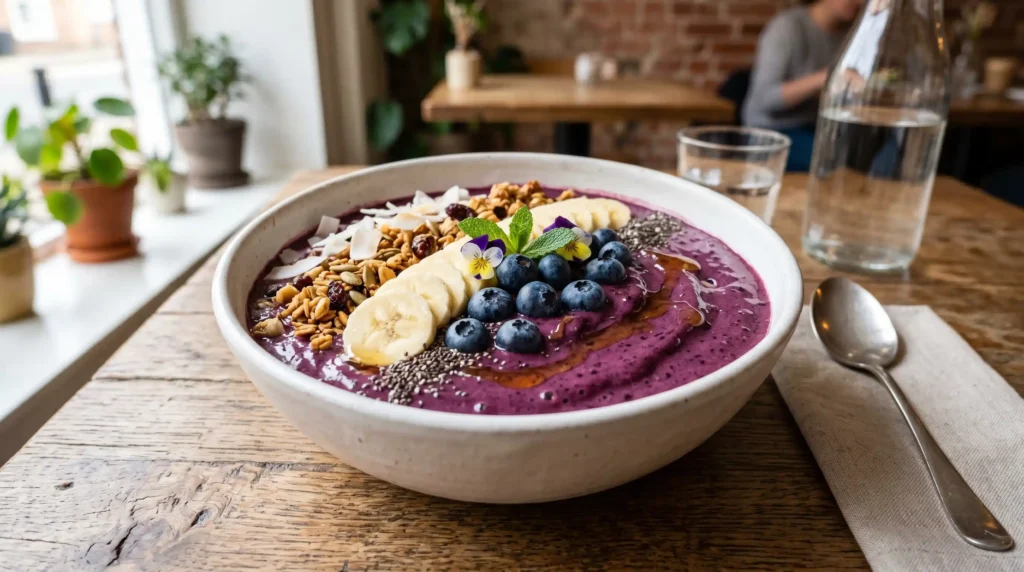
A regular blueberry smoothie is great. A Blueberry Smoothie Bowl is something you actually want to photograph before eating. Same flavour — more or less — but thicker, more satisfying, and topped with enough texture and colour that it genuinely looks like a meal someone cared about making. Which you did. In ten minutes. Nobody has to know the timeline.
I started making smoothie bowls when I got tired of drinking my breakfast standing over the sink. There is something about putting your morning nutrition in a bowl, sitting down, and eating it with a spoon that makes the whole experience feel more like a meal and less like a liquid vitamin. The blueberry version specifically became my default because the colour is extraordinary — that deep, vibrant indigo-purple that looks dramatic in any bowl you own.
Have you ever eaten something that genuinely improved your morning mood based purely on how beautiful it looked? That is the blueberry smoothie bowl effect. Let us make it properly.
What Makes a Smoothie Bowl Different From a Regular Smoothie
The fundamental difference is consistency. A smoothie pours freely from a blender and drinks through a straw. A smoothie bowl is thick enough to hold its shape in a bowl, support toppings without them sinking immediately, and eat with a spoon. Achieving this requires more frozen fruit and significantly less liquid than a drinkable smoothie — the liquid reduction and frozen fruit increase work together to produce a base that acts like soft-serve ice cream in a bowl.
The toppings are the other defining characteristic. A smoothie bowl is genuinely a different eating experience from a smoothie because of texture — every spoonful combines the smooth, cold, intensely flavoured base with granola crunch, fresh fruit brightness, and seed chew in a way that a glass of smoothie simply cannot deliver. The contrast of temperatures and textures makes every bite interesting.
From a practical standpoint, a smoothie bowl also fills you up more effectively than a drinkable smoothie of similar volume. The act of chewing toppings sends satiety signals to the brain that liquid consumption does not. IMO, a smoothie bowl is the format that should be the default — it tastes better, satisfies longer, and looks significantly more intentional.
What You Need
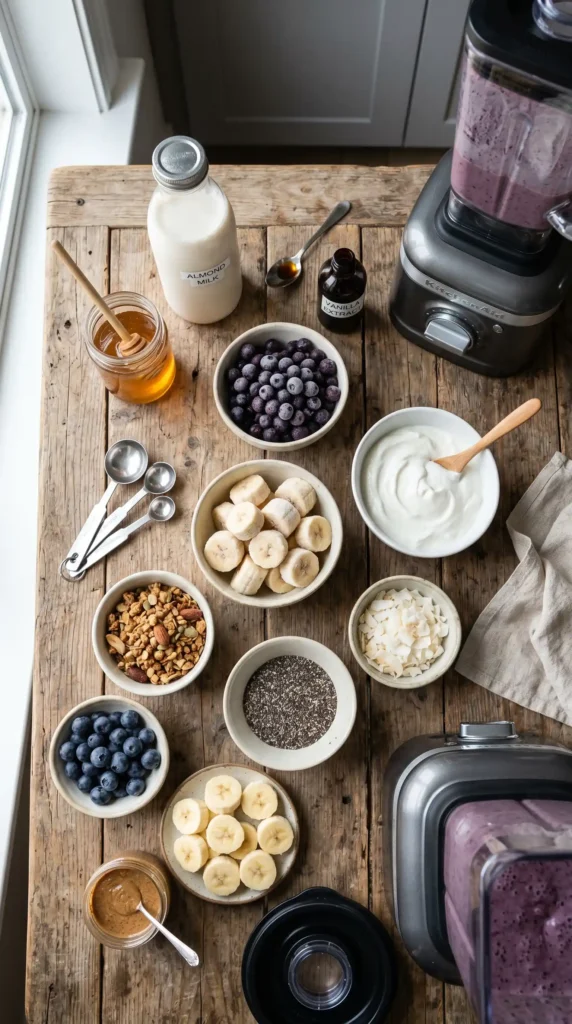
Two parts: the blueberry base and the toppings. The base requires minimal ingredients and blends in under a minute. The toppings are where personal expression happens — use what you have, what you love, and what looks beautiful together. The only rule for toppings is variety of texture: something crunchy, something fresh, something creamy or drizzled. Beyond that, the combination is entirely yours.
For the Blueberry Smoothie Bowl Base (Serves 1–2)
- 1 and 1/2 cups (225g) frozen blueberries — the main flavour component and the source of the dramatic purple colour
- 1 large frozen banana, broken into pieces before freezing — provides sweetness, body, and the creamy texture
- 1/2 cup (120g) full-fat Greek yogurt — adds protein, creaminess, and a mild tang that balances the blueberry sweetness
- 1/4 cup (60ml) unsweetened almond milk — use just enough liquid to get the blender moving; less liquid equals a thicker bowl
- 1 tablespoon honey or maple syrup (optional — taste first, the banana and blueberries may provide enough sweetness)
- 1/2 teaspoon vanilla extract
Suggested Toppings (Choose Your Combination)
- Crunch
- 1/4 cup granola, toasted coconut flakes, or crushed walnuts
- Fresh Fruit
- Fresh blueberries, sliced banana, strawberry halves, or kiwi slices
- Seeds
- 1 tsp hemp seeds, chia seeds, or flaxseed for omega-3s and protein
- Drizzle
- Honey, maple syrup, almond butter, or peanut butter thinned with a little warm water
- Extras
- Cacao nibs, bee pollen, goji berries, or dried mulberries for nutrition and visual interest
- Creamy Element
- A small spoonful of Greek yogurt, coconut cream, or almond butter placed in the centre
Less Liquid Is the Secret to a Thick Smoothie Bowl BaseThe number one reason smoothie bowls turn out too thin and liquid is adding too much milk or liquid to the blender. You need just enough liquid to get the blender moving and break down the frozen fruit — not enough to produce a pourable smoothie. Start with 1/4 cup and add more only if the blender stalls. A properly thick smoothie bowl base should look like soft-serve ice cream when you pour it into the bowl — it flows slowly and holds a slight peak. FYI — if it pours immediately flat, it has too much liquid.
How to Make a Blueberry Smoothie Bowl Step by Step
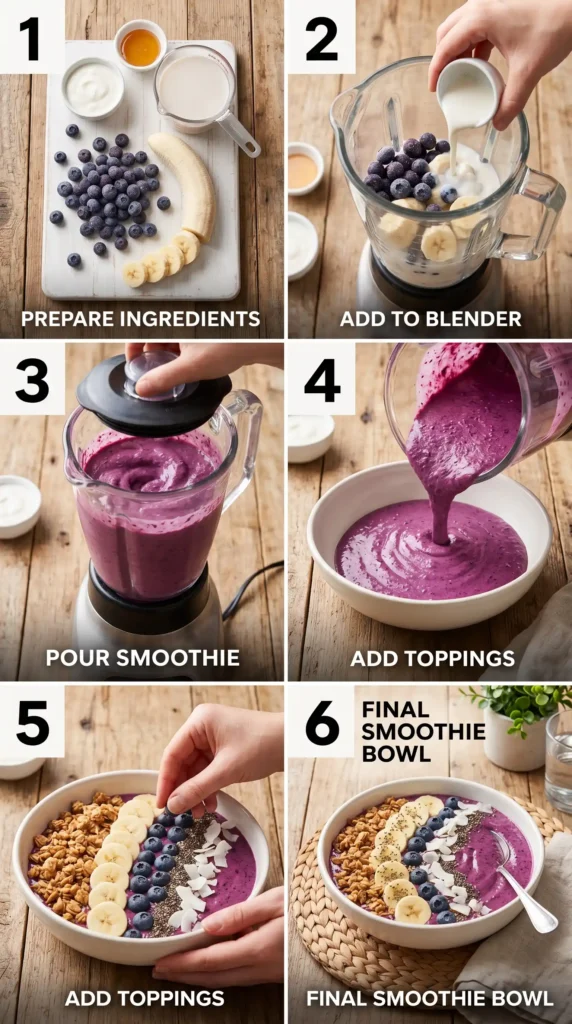
Ten minutes, one blender, and a bowl. The technical work is almost entirely in the blending — getting the consistency right requires attention to liquid quantity and blending technique. The topping arrangement requires attention to visual appeal and texture combination. Both are genuinely learnable in one attempt. Let us walk through each stage in proper detail.
Step 1: Prepare and Freeze Your Fruit in Advance
Both the blueberries and banana need to be frozen before blending. Frozen fruit is the source of the thick, cold, soft-serve consistency that makes smoothie bowls work as a format. Fresh fruit produces a thinner, room-temperature result that cannot support toppings properly and lacks the dramatically thick texture that defines a good smoothie bowl.
For the banana — peel it, break it into 4–5 pieces, and freeze in a zip-lock bag for at least 4 hours or overnight. For the blueberries, fresh blueberries can be spread on a tray and frozen for 2–3 hours then transferred to a bag, or you can buy frozen blueberries directly, which is the more convenient option and produces an identical result. Keep both in the freezer until the exact moment you are ready to blend.
Step 2: Pre-Chill Your Bowl
Place the bowl you plan to serve the smoothie bowl in into the freezer for 5–10 minutes before you make the base. This sounds like an unnecessary step and it is technically optional, but a cold bowl keeps the base thick and cold for significantly longer than a room-temperature bowl. A warm bowl causes the base to start melting within 2–3 minutes of being poured in, which reduces the time you have to arrange toppings beautifully and changes the eating texture.
Step 3: Blend the Base — Low Liquid First
Pour the almond milk into the blender first, using just 1/4 cup to start. Next, spoon the Greek yogurt on top. Then add the vanilla extract and honey, if you’re using it. Now add the frozen blueberries and frozen banana pieces on top — the heavy, dense frozen components go in last to be pulled down into the liquid by the spinning blades rather than sitting on top of the liquid and being immediately struck by them.
Start the blender on low speed for about 5 seconds. You may hear and feel the blender working harder than usual to break down the dense frozen fruit — this is correct and expected for a smoothie bowl base. Increase to medium speed for 10 seconds, then to full high speed. Use a tamper if your blender has one — push the ingredients down toward the blades while blending at high speed. If your blender does not have a tamper, stop it every 10 seconds, scrape down the sides with a spatula, and blend again.
Blend at full speed for 20–30 seconds maximum — just long enough to achieve a completely smooth, uniformly coloured base. Over-blending creates friction heat that melts the frozen fruit and produces a thinner, less cold result. The base is ready when it looks uniformly deep purple, completely smooth, and thick enough that it barely moves when you tilt the blender. If it looks like it has any lumps of frozen banana or unblended blueberry pieces, blend for another 10–15 seconds.
Step 4: Check the Consistency and Adjust
Before pouring, check the consistency. Tilt the blender slowly — the base should flow reluctantly and leave a thick coating on the blender walls rather than running freely like a liquid. If it flows freely like a smoothie, the base is too thin. You cannot fix an over-thinned base by blending — you would need to add more frozen fruit and blend again, which is always an option but requires having extra frozen fruit available.
If the base is too thick and the blender is struggling — making a labouring motor sound and not moving properly — add almond milk half a tablespoon at a time and blend briefly after each addition until the blades engage smoothly. This should require very little additional liquid — usually a tablespoon or less. Stop adding liquid the moment the blender runs smoothly and the base is still visibly thick.
Step 5: Pour and Arrange the Toppings
Pour the thick base into the pre-chilled bowl using a rubber spatula to scrape every last drop from the blender. The base should sit in the bowl with a gentle mound rather than spreading flat immediately — this is the sign of correctly thick consistency. Smooth the surface gently with the back of a spoon if needed to create a flat canvas for the toppings.
Now work quickly — you have about 3–5 minutes before the base starts softening around the edges from the warmth of the bowl (even pre-chilled). Arrange your toppings with intention: place granola across one side, fresh blueberries in a cluster, banana slices in a fan, seeds scattered across the centre. Drizzle honey or nut butter over the top in thin, even lines. The visual appeal of a Blueberry Smoothie Bowl comes from colour contrast and deliberate arrangement — take 60 seconds to arrange thoughtfully and the result looks genuinely beautiful rather than just dropped in. Serve immediately.
Tamper Vs. Stopping and Scraping — Know Your BlenderHigh-powered blenders like Vitamix and Blendtec come with a tamper specifically for thick blends like smoothie bowl bases — use it constantly while blending at high speed to push ingredients toward the blades. Standard blenders without tampers need to be stopped every 10–15 seconds and scraped down. Both approaches work; the tamper approach is faster and produces a smoother result.
Variations Worth Making
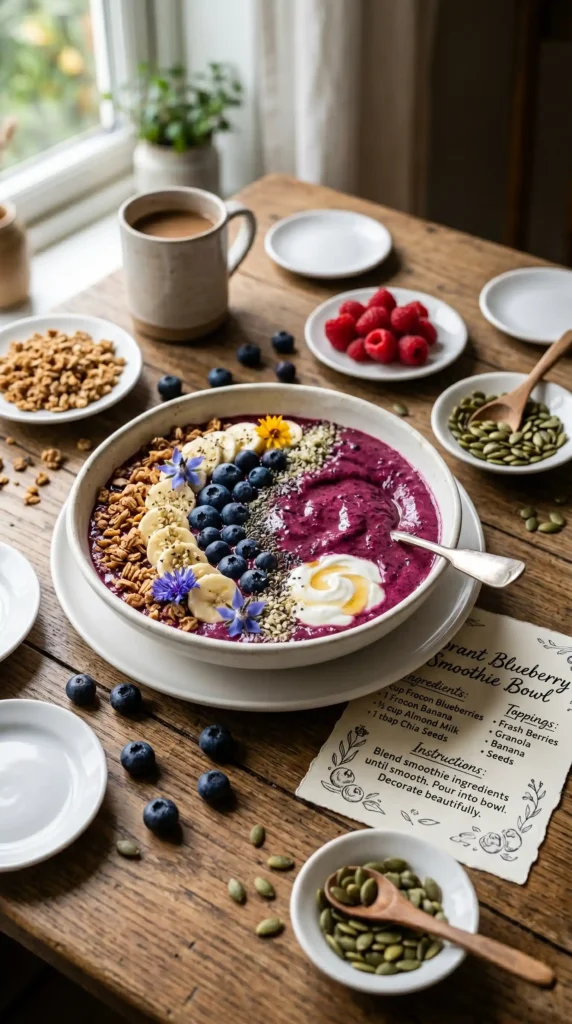
Triple Berry Smoothie Bowl
Replace the blueberries with a mix of frozen blueberries, frozen raspberries, and frozen strawberries — use 1/2 cup of each for a total of 1.5 cups. The triple berry base produces a more magenta-pink colour with a brighter, slightly tarter flavour than all-blueberry. Top with mixed fresh berries, sliced kiwi, and coconut flakes for a visually striking bowl that tastes like summer concentrated into a single meal.
Blueberry Açaí Bowl
Add one frozen açaí packet (100g, thawed slightly for 1 minute) to the base alongside the frozen blueberries. Reduce the banana to half and increase the Greek yogurt to 3/4 cup to maintain the right consistency. Açaí deepens the purple colour dramatically and adds a complex, slightly chocolatey berry flavour that elevates the base significantly. Top with granola, coconut flakes, and a generous drizzle of honey.
High-Protein Blueberry Bowl
Add one scoop of vanilla protein powder to the base blend. Increase the almond milk by 2 tablespoons to account for the additional dry ingredient. This version functions as a complete post-workout meal — the protein powder, Greek yogurt, and hemp seed topping together provide substantial protein content that the standard recipe alone does not. The protein powder integrates without producing a detectable supplement flavour when combined with the strong blueberry and banana base.
Make-Ahead and Storage Tips
A Blueberry Smoothie Bowl tastes best immediately after making — within the first 5–10 minutes while the base is still cold, thick, and fully set. Leftover base can be stored covered in the fridge for up to 6 hours, though it will thin slightly as it warms and separate somewhat at the surface. Stir vigorously before eating stored base, or re-blend briefly with a handful of additional frozen blueberries to restore the thick consistency.
The smartest make-ahead approach is the smoothie pack system — portion the frozen blueberries, frozen banana pieces, and measured almond milk into individual zip-lock bags and freeze everything together. On any morning, dump one bag into the blender with the Greek yogurt and blend. This reduces active morning prep to under two minutes and produces a consistently excellent result every time without any measuring.
Frequently Asked Questions
Why is my blueberry smoothie bowl too thin?
Too much liquid is almost always the cause. The 1/4 cup of almond milk in this recipe is intentionally minimal — just enough to get the blades moving through the dense frozen fruit. If you added more liquid instinctively, or if your frozen fruit was partially thawed before blending, the result will be too thin to support toppings. To rescue it, add half a cup of additional frozen blueberries to the blender and blend again at high speed to thicken the base back to a spoonable consistency.
Can I use fresh blueberries instead of frozen?
Fresh blueberries produce a thinner, warmer, less vibrant result — the frozen state of the berries is what creates the thick, cold, soft-serve consistency that defines a smoothie bowl. If you only have fresh blueberries, freeze them first: spread on a tray for 2–3 hours until solid, then use. In a real pinch, use fresh blueberries plus 1/2 cup of ice cubes — the ice compensates partially for the missing frozen fruit thickness, though the result is slightly grainier than the all-frozen version.
What blender works best for smoothie bowls?
High-powered blenders with 1,000 watts or more — Vitamix, Blendtec, Ninja — handle thick smoothie bowl bases most reliably. They come with tampers that push ingredients toward the blades and can process dense frozen fruit without stalling. Standard countertop blenders work with the stop-and-scrape technique described in the recipe, but require more patience and occasional liquid additions. Personal blenders like NutriBullet handle smoothie bowls less effectively since their small cups make the thick-base technique difficult to achieve without overfilling.
Can I make a blueberry smoothie bowl without banana?
Yes, though the banana provides both sweetness and the creamy texture that makes the base feel indulgent. Without banana, use 1/2 cup of frozen mango or frozen cauliflower florets — both provide body without a dominant banana flavour. Frozen cauliflower sounds unconventional but blends completely invisibly into the base and provides a thick, smooth texture with zero detectable taste. Increase the honey or maple syrup slightly to compensate for the sweetness the banana would have contributed.
How do I make the blueberry smoothie bowl base smooth without any chunks?
Two techniques guarantee a completely smooth base. First, soak the frozen fruit for 60 seconds at room temperature before blending — this slightly softens the surface without thawing the interior and reduces the initial blending resistance significantly. Second, use a tamper or stop-and-scrape method throughout the blending process rather than just starting the blender and walking away. Every time blending stalls, stop the motor, push ingredients toward the blades, and blend again. High-speed blending for 20–30 seconds with consistent agitation produces a completely smooth, lump-free base every time.
Final Thoughts
This Blueberry Smoothie Bowl earns its place as the most visually satisfying, most texturally interesting, and most genuinely enjoyable breakfast you can make in ten minutes. The vivid purple base, the layered toppings, the contrast of cold smooth base against crunchy granola and fresh fruit — it covers every element of a great meal in a format that suits any morning regardless of how much time you have.
Get the liquid quantity right, work with frozen fruit, pre-chill the bowl, and arrange the toppings with at least 60 seconds of deliberate attention. Those four decisions produce a result that looks and tastes genuinely special rather than just nutritionally adequate. And genuinely special breakfast is something every morning deserves.
Freeze those blueberries tonight. Peel and freeze a banana while you are at it. Wake up tomorrow with everything ready and ten minutes standing between you and the most beautiful bowl of breakfast you have ever made. IMO, that is a very good reason to actually get out of bed.
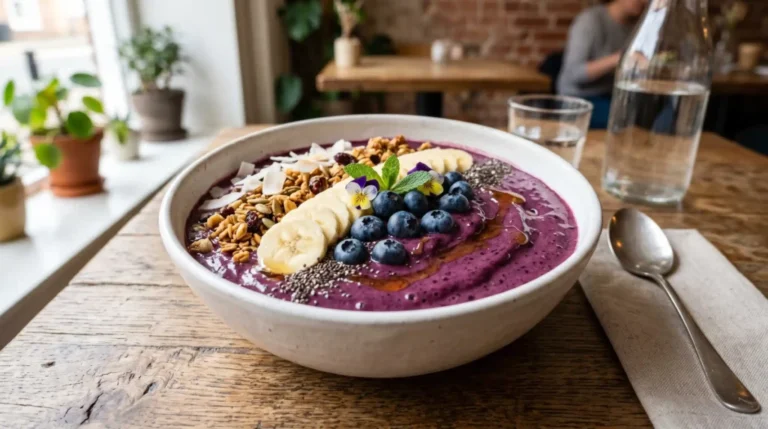
Blueberry Smoothie Bowl
Ingredients
Method
- Freeze the blueberries and banana in advance.
- Peel the banana, break into pieces, and freeze for at least 4 hours.
- Place the serving bowl into the freezer for 5–10 minutes for pre-chilling.
- Add almond milk to the blender first, followed by Greek yogurt, vanilla extract, and honey.
- Then add the frozen blueberries and banana pieces on top.
- Start blending on low speed for about 5 seconds, then increase to medium speed for 10 seconds, and finally to high speed for 20–30 seconds.
- Stop and scrape down the sides as needed to ensure a smooth blend.
- Pour the thick smoothie base into the pre-chilled bowl.
- Quickly arrange your desired toppings over the base.
- Serve immediately for the best texture and temperature.