Prep Time: 45 minutes | Bulk Ferment: 4-8 hours | Cold Proof: 8-12 hours (overnight) | Bake Time: 20-24 minutes | Servings: 12 mini bundts
Three Great Things Walked Into a Bundt Pan
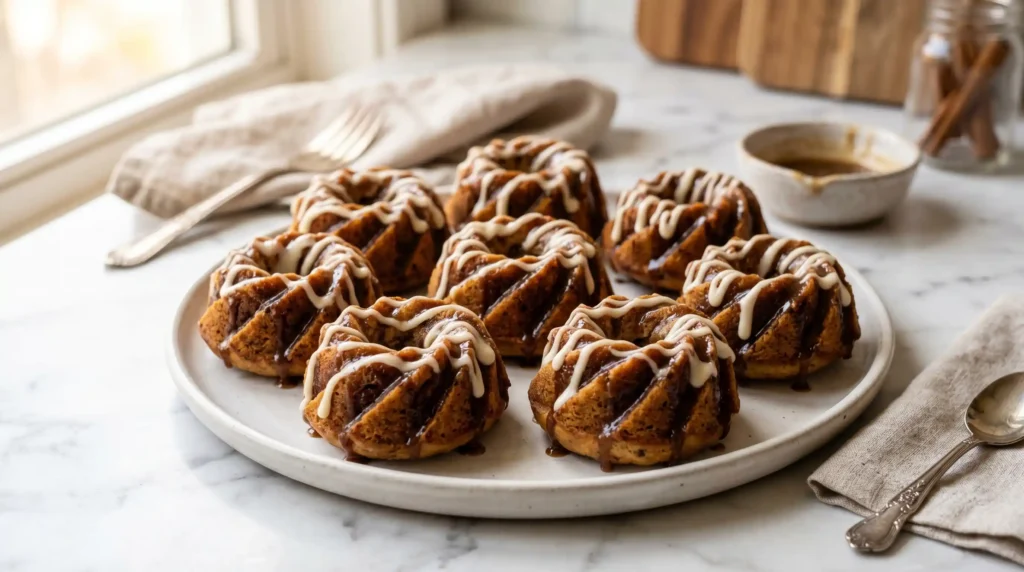
Mini Brown Butter Sourdough Cinnabundts. Three things that are already outstanding on their own. Now imagine someone decided to combine all three into a single mini bundt cake. That person was a genius and we owe them a debt.
Mini Brown Butter Sourdough Cinnabundts are exactly what they sound like — individual-sized bundt cakes made with a naturally leavened sourdough dough, layered with brown butter and warm cinnamon sugar, then glazed to perfection.
I made these for the first time on a long weekend when I had active sourdough starter and no patience for a regular loaf. Best impulse baking decision I’ve made in years. These little bundts are now on permanent rotation.
Does the process take some time? Yes. Is it absolutely worth it? Without question.
What Makes This Recipe So Special
The brown butter is the first layer of flavor magic here. Browning butter transforms it from something simple into something deeply nutty and almost caramel-like. That flavor weaves through every part of the dough and filling.
The sourdough component adds a subtle tang and incredible depth that you simply don’t get from a standard yeast dough. It also produces a more complex crumb texture — slightly chewy, deeply soft, and genuinely satisfying in a way that instant yeast just can’t replicate.
The mini bundt format is IMO the smartest choice for this recipe. Individual portions mean everyone gets their own perfectly glazed piece, and the bundt shape creates extra surface area for glaze to pool into the ridges. More glaze coverage. Always the right call.
Have you ever bitten into something that tasted like a cinnamon roll and a fancy pastry had a baby? That’s this recipe.
Complete Ingredient List with Quantities
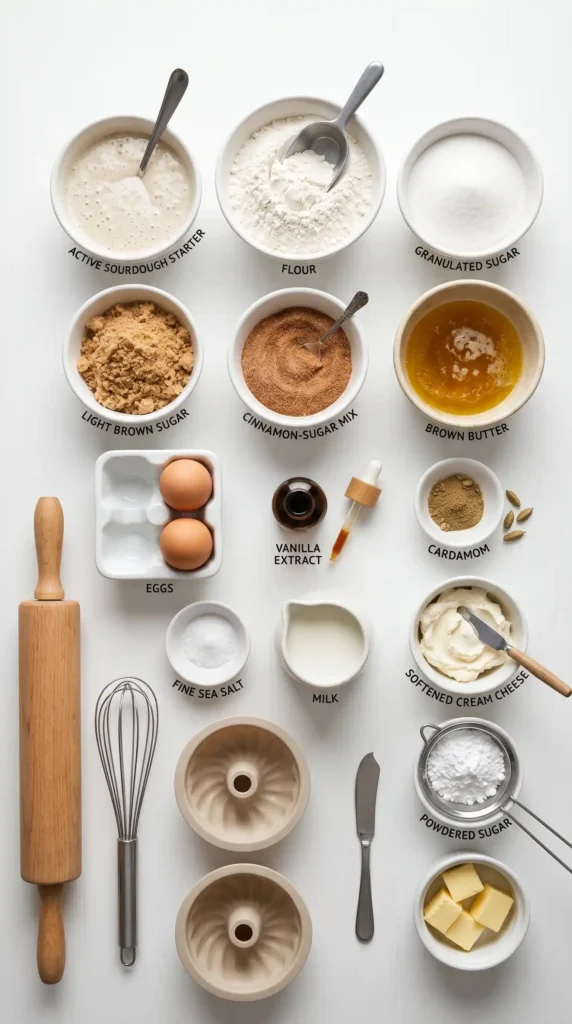
For the Sourdough Dough
Make sure your starter is active and bubbly before you begin. If it passed the float test recently, you’re good to go. A sluggish starter produces a dense, under-risen dough — not the result we’re after here.
- 100g (about 1/2 cup) active sourdough starter, recently fed and bubbly
- 300g (2 1/2 cups) bread flour
- 50g (1/4 cup) whole milk, warmed to about 90 degrees F
- 50g (3 1/2 tablespoons) unsalted butter, browned and cooled (see brown butter step)
- 2 large eggs, at room temperature
- 50g (1/4 cup) granulated sugar
- 6g (1 teaspoon) fine sea salt
For the Brown Butter Cinnamon Filling
This filling is what separates these from any other sourdough bun you’ve ever tasted. The brown butter base carries the cinnamon sugar into every layer of the rolled dough.
- 60g (4 tablespoons) unsalted butter, browned and cooled to spreadable consistency
- 100g (1/2 cup) light brown sugar, packed
- 2 teaspoons ground cinnamon
- 1/4 teaspoon ground cardamom (optional but highly recommended)
- Pinch of fine sea salt
For the Brown Butter Cream Cheese Glaze
A plain sugar glaze works fine, but this brown butter cream cheese version is what makes people ask for the recipe. It’s thick, tangy, and deeply flavored. Don’t skip it.
- 115g (4 oz) cream cheese, fully softened
- 30g (2 tablespoons) unsalted butter, browned and cooled
- 120g (1 cup) powdered sugar, sifted
- 2-3 tablespoons whole milk, to thin
- 1/2 teaspoon pure vanilla extract
- Pinch of salt
For the Pan
- Softened butter and flour for greasing the mini bundt pan
How to Make Mini Brown Butter Sourdough Cinnabundts
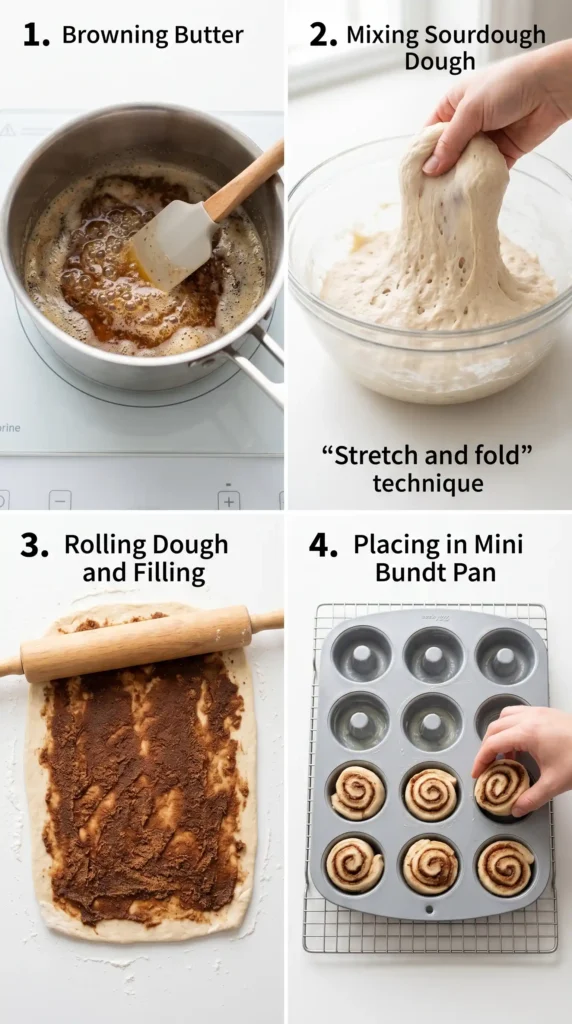
Mini Brown Butter Sourdough Cinnabundts This is a multi-stage recipe — the kind where you do the heavy lifting on day one and wake up to something incredible on day two. Read through all the steps before you start so nothing surprises you.
Step 1: Brown Your Butter (Do This First and Do It for All Three Uses)
You need brown butter for the dough, the filling, and the glaze. Make it all at once to save time. Place 150g (about 10 tablespoons) of unsalted butter in a light-colored saucepan over medium heat.
Stir the butter constantly as it melts. It will foam, then the foam will subside, and you’ll start seeing small golden-brown bits forming on the bottom of the pan. That’s the milk solids browning — that’s exactly what you want.
The moment the butter smells nutty and toasty and turns a deep amber color, remove it from the heat immediately and pour it into a heatproof bowl. Browning happens fast at the end — stay at the stove and don’t walk away.
Divide the brown butter into three portions: 50g for the dough, 60g for the filling, and 30g for the glaze. Let all three cool completely before using. The dough portion needs to reach room temperature, and the filling portion should be soft but not liquid.
Step 2: Mix and Develop the Dough
In a large bowl, combine 100g of active starter, the 50g of warm milk, and the 2 eggs. Whisk briefly until the mixture looks roughly combined. Don’t worry about perfection at this stage — it all comes together.
Add the 300g of bread flour, 50g of sugar, and 6g of salt. Mix with your hands or a dough scraper until no dry flour remains. The dough will feel shaggy and rough — that’s normal. Cover and let it rest for 30 minutes.
After the rest, add the 50g of cooled brown butter. Incorporate it by squeezing the butter through the dough repeatedly until fully absorbed. This takes about 5 minutes and the dough will feel greasy at first before coming back together.
Once the butter is incorporated, perform stretch-and-fold sets every 30 minutes for the first 2 hours of bulk fermentation. To do a set, grab one side of the dough, stretch it upward firmly, then fold it over itself. Rotate the bowl 90 degrees and repeat four times per set.
Step 3: Bulk Ferment
Cover the bowl and let the dough bulk ferment at room temperature for 4 to 8 hours total. The exact time depends on your kitchen temperature and the strength of your starter.
A warm kitchen (75 to 78 degrees F) will ferment in 4 to 5 hours. A cooler kitchen (68 to 72 degrees F) needs closer to 6 to 8 hours. The dough is ready when it has grown by about 50 percent and looks domed, bubbly, and airy at the edges.
Don’t rush this step. Under-fermented dough produces dense, gummy bundts. Over-fermented dough loses structure and spreads in the pan. Learn your dough’s rhythm and trust the visual cues over the clock.
Step 4: Make the Cinnamon Filling
While the dough ferments, make your filling. In a small bowl, combine the 100g of packed brown sugar, 2 teaspoons of cinnamon, 1/4 teaspoon of cardamom if using, and the pinch of salt. Stir until evenly mixed.
Make sure your 60g of brown butter filling portion has cooled to a thick, spreadable consistency — similar to softened butter. If it’s still liquid, let it sit at room temperature a bit longer. It needs to spread cleanly without soaking into the dough.
Step 5: Shape and Fill the Bundts
Once bulk fermentation is complete, lightly flour your work surface and turn the dough out. Gently press it into a rough rectangle without deflating it too aggressively. You want to preserve some of that fermentation structure.
Use a rolling pin to roll the dough into a rectangle roughly 12 inches by 16 inches. Aim for an even thickness of about 1/4 inch throughout.
Spread the brown butter evenly across the entire surface using a spatula or the back of a spoon. Then scatter the cinnamon sugar mixture evenly over the butter layer, covering the dough all the way to the edges. Press the sugar down lightly with your palm so it adheres.
Starting from the long edge closest to you, roll the dough into a tight log. Keep the tension firm and even as you roll — a loose roll creates gaps in the layers once baked. Pinch the seam closed along the length of the log.
Cut the log into 12 equal rounds using a sharp knife or unflavored dental floss. Dental floss gives a cleaner cut without compressing the layers the way a knife sometimes does. Each round should be about 1 to 1.5 inches thick.
Grease your mini bundt pan thoroughly with softened butter, then dust with flour. Place each round cut-side up into a bundt cavity. The swirl should face upward and the layers should be visible. Cover loosely with plastic wrap.
Step 6: Cold Proof Overnight
Refrigerate the filled pan for 8 to 12 hours overnight. This cold proof slows fermentation right down and develops the sour, complex flavor that makes these bundts genuinely different from any standard cinnamon roll.
The cold also firms up the dough, which makes it easier to handle and helps the bundts hold their shape during baking. This overnight step is a feature, not a chore — it does real flavor work while you sleep.
Step 7: Bake
The next morning, remove the pan from the fridge and let it sit at room temperature for 30 to 45 minutes while you preheat your oven to 375 degrees Fahrenheit. This brief warm-up takes the chill off and helps the bundts rise a little more before hitting the heat.
Bake for 20 to 24 minutes. The bundts are done when they look deep golden brown on top, feel set in the center when gently pressed, and smell intensely of cinnamon and browned butter. Those are your real doneness cues.
Let the bundts cool in the pan for exactly 10 minutes before inverting them onto a wire rack. Don’t wait longer than 15 minutes or the caramelized sugar in the filling can harden and stick to the pan. Ten minutes is the sweet spot.
Step 8: Make the Glaze and Finish
Beat the 115g of softened cream cheese until completely smooth. Add the 30g of cooled brown butter and beat again until combined and lump-free. Sift in the 120g of powdered sugar and add the vanilla extract and pinch of salt.
Mix until smooth, then add milk one tablespoon at a time until the glaze reaches a thick but pourable consistency — similar to a slow-moving lava 🙂 You want it to coat the back of a spoon and drip slowly when poured.
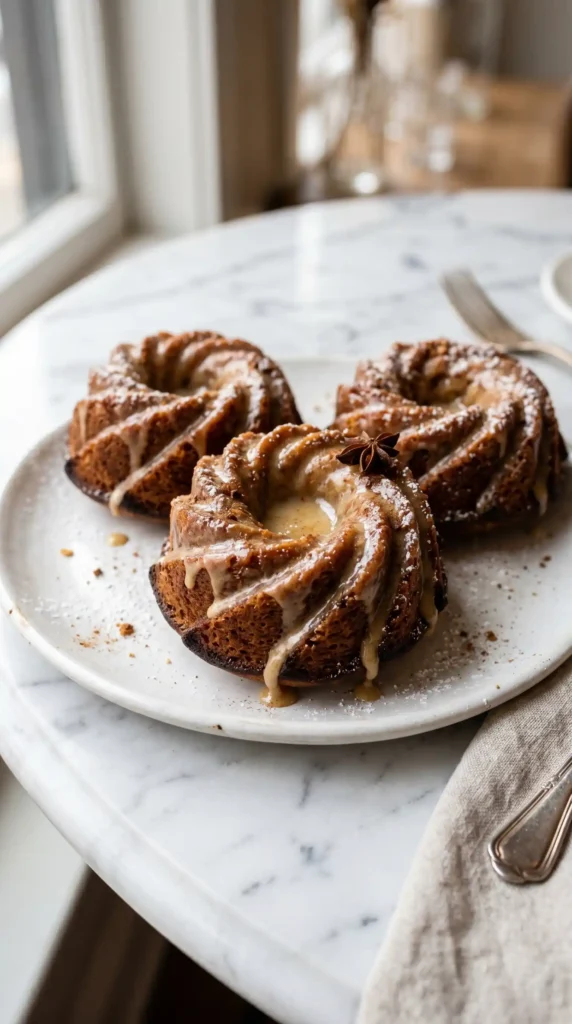
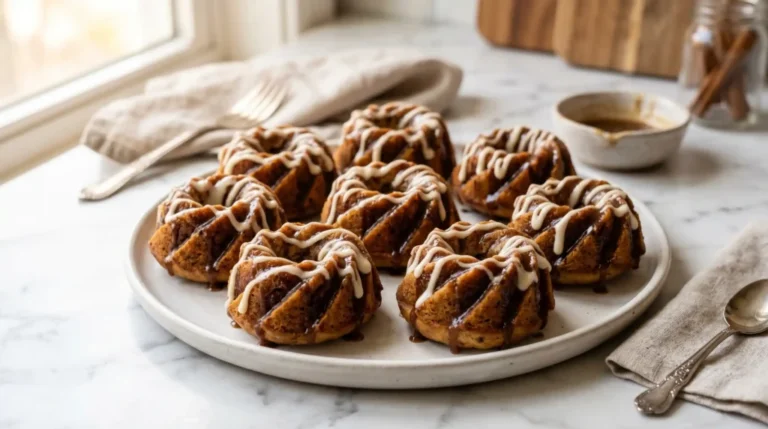
Spoon or pour the glaze generously over each warm bundt, letting it drip into the grooves and pool around the base. Glaze them while they’re still warm so it soaks in slightly rather than just sitting on the surface.
Practical Tips That Actually Help
- Active starter is non-negotiable: Feed your starter 4 to 6 hours before you start. It should be doubled, bubbly, and passing the float test. A weak starter produces flat, dense bundts.
- Brown butter quality matters: Use a light-colored pan so you can see the color change clearly. Dark pans hide the browning and lead to burned butter, which tastes bitter rather than nutty.
- Don’t skip the cardamom: It sounds minor but it adds a floral warmth that makes the filling noticeably more complex. FYI — even people who don’t know what cardamom is will taste the difference and comment on it.
- Grease the pan generously: Mini bundt pans have detailed grooves that trap caramelized sugar. Be thorough with the butter and flour — every ridge needs coverage.
- Trust the overnight proof: The slow cold fermentation develops flavor you simply can’t rush. These taste noticeably better than a same-day version.
Frequently Asked Questions
Can I make Mini Brown Butter Sourdough Cinnabundts without a mini bundt pan?
Yes. A standard muffin tin works as a substitute — just reduce the bake time to 16 to 18 minutes. The shape will be different but the flavor stays exactly the same. You can also bake them in an 8×8 inch pan as a pull-apart version, adding about 5 minutes to the bake time.
My dough feels really sticky. Is that normal?
Yes, enriched sourdough doughs with butter and eggs feel stickier than a plain bread dough. Resist the urge to add more flour — extra flour tightens the crumb and makes the bundts less tender. Lightly flour your hands during shaping instead of adding flour directly to the dough.
Can I use discard instead of active starter?
You can, but the results will be noticeably different. Discard doesn’t have enough active yeast to leaven the dough properly on its own, so the bundts will be denser and less risen. If you use discard, add 1/4 teaspoon of instant yeast to compensate — it’s not the same, but it works in a pinch.
How do I store leftovers?
Store leftover bundts in an airtight container at room temperature for up to 2 days or in the refrigerator for up to 4 days. To reheat, warm them in a 300-degree oven for about 8 minutes or microwave for 20 to 25 seconds. Add a fresh drizzle of glaze after reheating for best results.
Can I freeze these bundts?
Yes. Freeze the bundts without glaze in a single layer until solid, then transfer to a freezer-safe bag. They keep well for up to 2 months. Thaw overnight in the fridge, then reheat and glaze fresh. The texture holds up surprisingly well through freezing and reheating.
What hydration should my starter be for this recipe?
A 100% hydration starter (equal weights flour and water) works best here. It incorporates smoothly into the dough and produces reliable results. If you maintain a stiffer starter, loosen it slightly with a little extra water before adding it to the dough.
Final Thoughts
Mini Brown Butter Sourdough Cinnabundts reward patience. The brown butter adds layers of nutty depth, the sourdough delivers genuine complexity, and the mini bundt format makes every single piece feel like its own special occasion.
Yes, this recipe takes two days. But the active time is manageable, and the overnight proof does all the real work while you sleep. Day-two you gets to pull gorgeous little bundts out of the oven and act very calm about it.
Get your starter fed this evening. Tomorrow morning, your kitchen will smell incredible and you will feel very accomplished. You deserve both of those things
Happy baking. Go make something extraordinary.
Mini Brown Butter Sourdough Cinnabundts
Ingredients
Method
- Brown Your Butter: Place 150g of unsalted butter in a light-colored saucepan over medium heat. Stir constantly until it reaches a deep amber color and smells nutty. Divide into portions for the dough, filling, and glaze.
- Mix and Develop the Dough: In a large bowl, combine the active starter, warm milk, and eggs. Whisk and add bread flour, sugar, and salt. Mix until no dry flour remains. Let rest for 30 minutes.
- Incorporate the cooled brown butter into the dough by squeezing it through until fully absorbed.
- Perform stretch-and-fold sets every 30 minutes for 2 hours.
- Let dough bulk ferment at room temperature for 4 to 8 hours until it has grown about 50%.
- Make the Cinnamon Filling: Combine brown sugar, cinnamon, cardamom (if using), and salt in a bowl.
- Once the dough has fermented, lightly flour a surface and roll it out into a rectangle. Spread brown butter evenly and sprinkle cinnamon sugar mixture on top.
- Roll the dough tightly and cut into 12 rounds using dental floss. Place in a greased mini bundt pan.
- Cover and refrigerate the filled pan overnight for 8 to 12 hours.
- Preheat the oven to 375°F and remove the pan from the fridge to sit for 30 to 45 minutes.
- Bake for 20 to 24 minutes until golden brown and set in the center.
- Cool in the pan for 10 minutes before inverting onto a wire rack.
- Make the glaze by beating cream cheese until smooth. Add the brown butter and mix again. Sift in powdered sugar and add milk until the desired consistency is reached.
- Generously glaze the warm bundts, allowing the glaze to soak into the grooves.