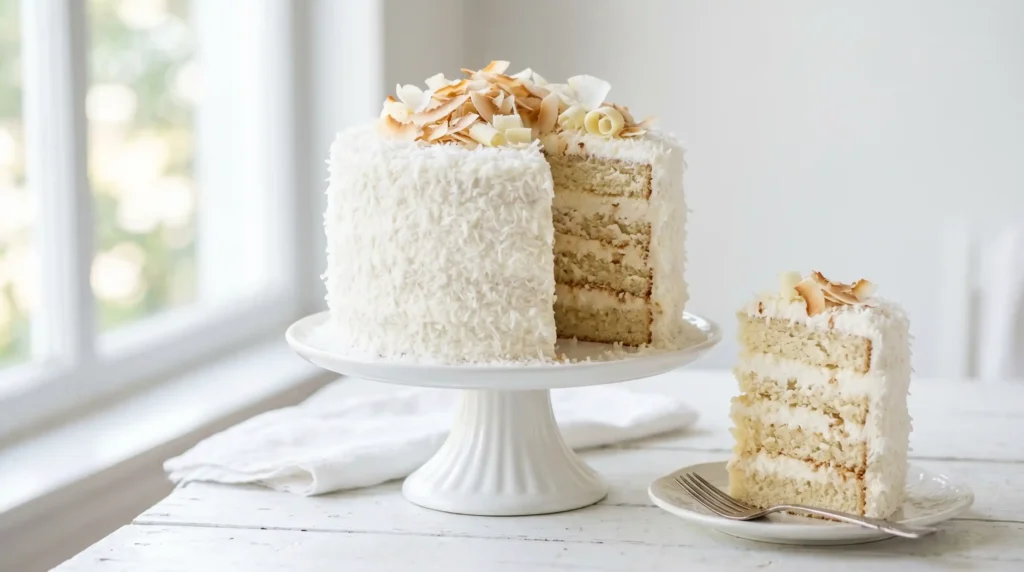
Some cakes look impressive. Some taste impressive. The rarest kind does both, and does it with a flavour that feels like dessert and sunshine simultaneously. Coconut Cloud Cake earns its name — the layers are genuinely soft and light from coconut milk and sour cream, the frosting is airy and creamy from whipped topping folded into cream cheese, and the whole cake is blanketed in so much coconut that it looks like something you would find outside a window during a particularly theatrical snowstorm. In the best possible way.
I have made a lot of coconut cakes over the years — some that tasted coconutty enough, some that looked the part, and a few that were both but compromised on texture. This version gets all three simultaneously. The coconut extract in both the cake batter and the frosting ensures you can actually taste the coconut rather than just vaguely sense it, and the sour cream in the batter produces a crumb so tender that the layers feel dramatically different from a standard vanilla cake with coconut flavouring dropped in as an afterthought.
Have you ever sliced a cake and had the whole table lean in just from the appearance of the cross-section? That is the Coconut Cloud Cake effect. Let us make it properly.
What Makes This the Best Coconut Cloud Cake Recipe
Most coconut cakes use regular milk or buttermilk in the batter and add coconut flavour through extract alone. This recipe uses both coconut milk and coconut extract — the coconut milk provides moisture, fat, and a subtle natural coconut flavour that extract alone cannot replicate, while the coconut extract amplifies and focuses the coconut note to a clearly identifiable level throughout every crumb.
The sour cream is the texture secret. It adds fat and a mild acidity to the batter that reacts with the baking powder and baking soda to produce an exceptionally tender, tight crumb. Sour cream cakes stay moist longer than cakes made with liquid dairy alone — the fat content from the sour cream prevents the crumb from drying out as quickly after baking. The result is a cake that tastes as good on day two as on day one.
The frosting is genuinely different from a standard cream cheese buttercream. Folding thawed whipped topping into the cream cheese and butter base produces a frosting that is simultaneously stable and incredibly airy — it holds its shape for piping and spreading but feels light and cloud-like rather than heavy and dense when eaten. IMO, this frosting is the single most important upgrade over standard coconut cake frosting and the element that earns the “cloud” in the name.
What You Need
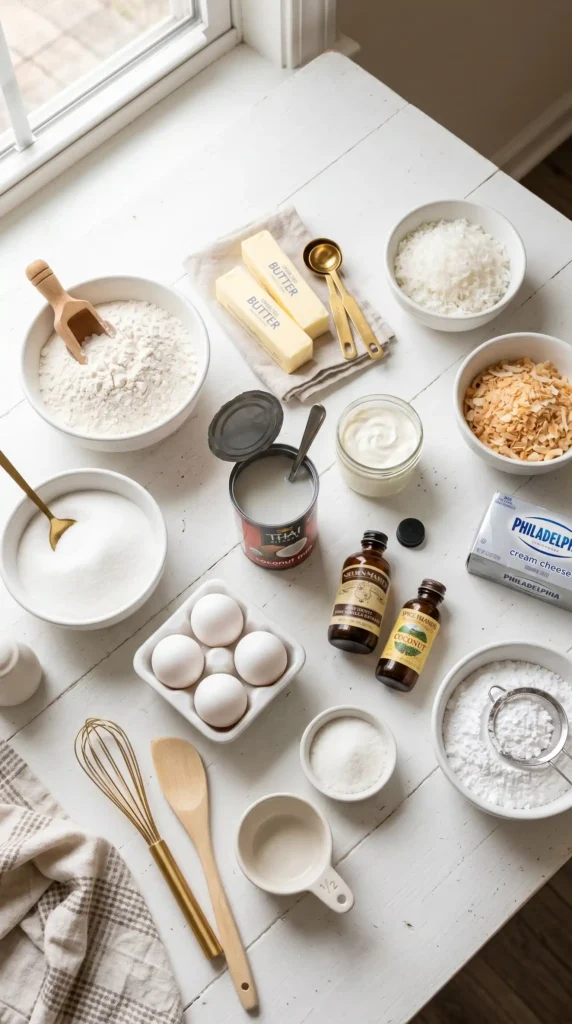
Three components: the cake layers, the coconut cream frosting, and the toppings. The sour cream must be full-fat — reduced-fat sour cream contains more water and produces a slightly gummy, less tender crumb. The coconut milk should be well-stirred canned coconut milk at room temperature — shake the can vigorously before opening to ensure the fat and liquid are fully combined before measuring.
For the Coconut Cloud Cake Layers (Makes 2 x 23cm layers or 3 x 20cm layers)
- 2 and 1/2 cups (315g) all-purpose flour
- 2 and 1/2 teaspoons baking powder
- 1/2 teaspoon baking soda
- 1/2 teaspoon salt
- 1 cup (226g) unsalted butter, softened to room temperature
- 1 and 3/4 cups (350g) granulated white sugar
- 4 large eggs, room temperature
- 1 teaspoon pure vanilla extract
- 1 teaspoon coconut extract — this is non-negotiable for a cake that tastes distinctly of coconut
- 1 cup (240ml) full-fat canned coconut milk, well-stirred, room temperature
- 1/2 cup (120g) full-fat sour cream, room temperature
For the Coconut Cream Frosting
- 1 package (225g / 8oz) full-fat cream cheese, softened to room temperature
- 1/2 cup (113g) unsalted butter, softened to room temperature
- 3–4 cups (360–480g) powdered sugar, sifted
- 1 teaspoon coconut extract
- 1 container (225g / 8oz) whipped topping (Cool Whip or equivalent), fully thawed
Now For the Coconut Toppings
- 1 and 1/2 cups (120g) sweetened shredded coconut — for covering the sides and top
- 1/2 cup (40g) toasted coconut flakes — for the top; toast in a dry pan over medium heat for 3–5 minutes until golden
- White chocolate curls (optional) — shaved from a block of white chocolate with a vegetable peeler for an elegant finish
Room Temperature Everything — The Most Important Instruction in This RecipeButter, eggs, sour cream, and coconut milk all need to be genuinely at room temperature before mixing. Cold butter won’t cream properly with sugar, leading to a dense batter instead of a light, fluffy one. Eggs and sour cream straight from the fridge can shock the creamed butter, causing it to seize or curdle. Cold coconut milk also blends unevenly and can break the smooth texture of the mixture. Pull all dairy and egg ingredients from the fridge at least 90 minutes before baking. FYI — this single step has more impact on the final cake texture than any other preparation decision.
How to Make Coconut Cloud Cake Step by Step
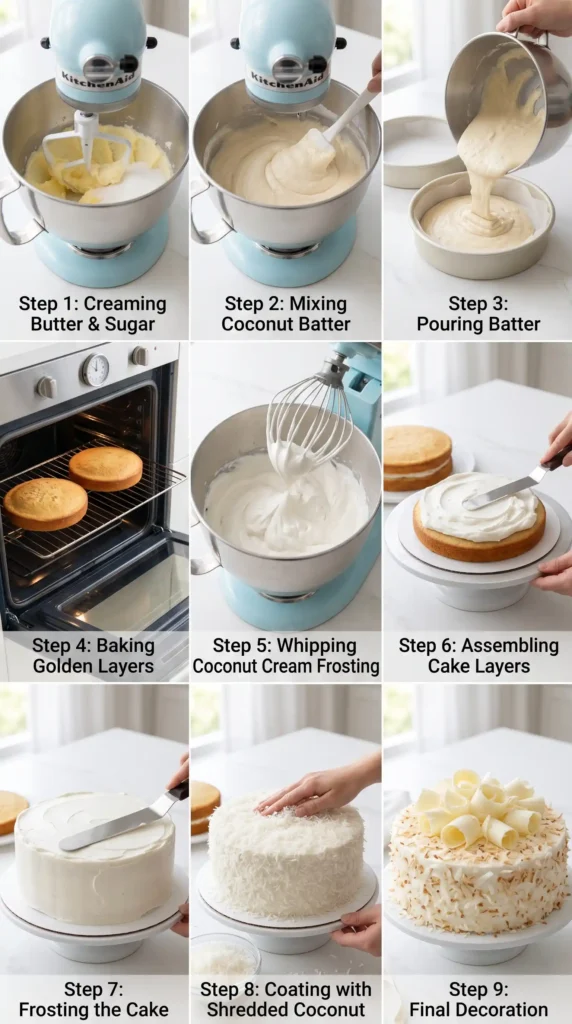
Four stages: make and bake the cake layers, make the frosting, assemble and frost, then coat in coconut. The cake layers require the most technical attention — creaming time, egg addition order, and flour alternation method all directly affect the final texture. The frosting and assembly are relatively forgiving. Walk through each stage in sequence and the result will be exactly what the name promises.
Step 1: Prepare and Bake the Cake Layers
Preheat and Prepare the Pans
Preheat your oven to 175°C (350°F). Grease and flour two 23cm (9-inch) round cake pans or three 20cm (8-inch) pans. Line the bottom of each pan with parchment paper for easy release.
Mix the Dry Ingredients
In a medium bowl, whisk together the flour, baking powder, baking soda, and salt until evenly combined. Set aside so the leavening agents are fully distributed.
Combine the Wet Ingredients
In a separate jug, stir together the room-temperature coconut milk and sour cream. They do not need to be fully smooth—just lightly combined for easier mixing later.
Cream Butter and Sugar
In a large bowl, beat the softened butter and granulated sugar on medium-high speed for 4–5 minutes. The mixture should become very pale, light, and airy. This step is essential for creating a fluffy cake structure.
Add the Eggs and Extracts
Add the eggs one at a time, beating for 20–25 seconds after each addition. Once all eggs are incorporated, mix in the vanilla and coconut extract. The batter should look smooth and slightly fluffy. If it appears curdled, it likely means the ingredients were too cold.
Alternate Wet and Dry Ingredients
Add the dry mixture and coconut milk mixture in alternating stages, starting and ending with the dry ingredients. Mix on low speed and stop as soon as no flour streaks remain to avoid overdeveloping gluten.
Bake the Cake
Divide the batter evenly between the prepared pans and smooth the tops. Bake on the center rack for 28–32 minutes, or until a toothpick inserted in the center comes out clean and the edges begin to pull away from the pan.
Cool Completely
Let the cakes cool in the pans for 15 minutes, then transfer to a wire rack. Allow them to cool fully for at least 90 minutes before frosting to ensure the structure is stable.
Step 2: Make the Coconut Cream Frosting
Beat the softened cream cheese on medium speed for 60–90 seconds until completely smooth and lump-free. Add the softened butter and beat for about 60 seconds until the mixture becomes smooth and uniform. Next, incorporate the sifted powdered sugar gradually, adding one cup at a time on low speed—adding it all at once will create a cloud of sugar that takes over your kitchen. Finish by mixing in the coconut extract and beating just until everything is fully combined.
Increase mixer speed to medium-high and beat for 2 minutes until the frosting looks fluffy and holds a firm shape. Now fold in the fully thawed whipped topping in two additions using a rubber spatula — fold gently with large strokes from the bottom of the bowl upward until no white streaks of whipped topping remain visible. The finished frosting should look noticeably lighter and airier than before the whipped topping was added — cloud-like in texture, stable enough to hold its shape, and flavoured distinctly of coconut throughout.
Step 3: Toast the Coconut for Topping
Spread the coconut flakes in a single layer in a dry skillet over medium heat. Stir constantly — toasted coconut goes from golden to burnt in under 30 seconds once it starts browning. After about 3–5 minutes, the flakes should look golden-amber throughout and smell deeply nutty and aromatic. Remove immediately from the heat and spread on a plate to cool. Set aside for the finishing decoration.
Step 4: Assemble and Frost the Cake
Place the first fully cooled cake layer on a cake stand or flat serving plate. Apply a generous, even layer of the coconut cream frosting across the top — about one quarter of the total frosting for a two-layer cake. Place the second layer on top, aligning it carefully. Apply a thin crumb coat of frosting over the entire exterior — top and sides — to seal any loose crumbs against the surface. Refrigerate for 15 minutes until the crumb coat firms.
Apply the final smooth coating of frosting over the crumb-coated cake, building up a thick, even layer on the sides and a flat or gently domed layer on top. Immediately press the sweetened shredded coconut firmly against the sides of the cake while the frosting is still soft — work upward from the base, pressing small handfuls against the frosting and letting any excess fall away. Scatter more shredded coconut across the top surface and smooth gently with your hand.
Scatter the toasted coconut flakes across the top of the Coconut Cloud Cake in the centre of the shredded coconut for contrast between the pale shredded and golden toasted. Add white chocolate curls if using. Refrigerate the assembled cake for at least 30 minutes before slicing to allow the frosting to firm for the cleanest possible cuts.
Variations Worth Making
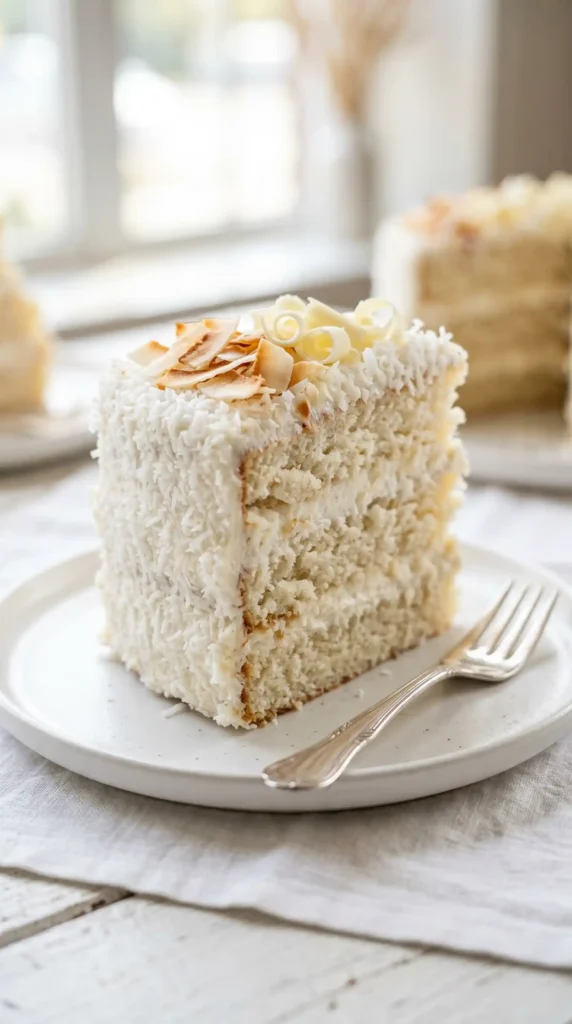
Lemon Coconut Cloud Cake
Add 2 tablespoons of fresh lemon zest and 1 tablespoon of fresh lemon juice to the cake batter alongside the vanilla and coconut extract. Make a lemon coconut curd filling — combine lemon juice, sugar, eggs, and butter over a double boiler — to spread between the cake layers before frosting. The lemon version tastes brighter and more summer-appropriate than the pure coconut version and suits warm-weather celebrations particularly well.
Raspberry Coconut Cloud Cake
Spread a thin layer of raspberry jam or fresh raspberry compote over each cake layer before adding the frosting layer. The tart, bright raspberry cuts through the richness of the coconut frosting and produces a flavour combination that tastes more complex and balanced than the coconut-only version. Use freeze-dried raspberries crushed over the top of the finished cake for colour contrast against the white coconut exterior.
Storage Tips
Store the Coconut Cloud Cake covered in the refrigerator for up to 5 days — the whipped topping in the frosting requires refrigeration to maintain stability. Allow individual slices to sit at room temperature for 15–20 minutes before eating to allow the frosting to soften from its refrigerator firmness to its optimal light, airy texture. Cold frosting directly from the fridge tastes denser and less impressive than the same frosting at a slightly warmer temperature.
The unfrosted, cooled cake layers freeze beautifully for up to 3 months. Wrap each layer individually in cling film and then foil. Thaw at room temperature for 2 hours before frosting. The frosting does not freeze well due to the whipped topping component — make it fresh on the day of frosting for the best texture and stability.
Frequently Asked Questions
Can I use coconut cream instead of coconut milk in the cake batter?
Yes, though the cake will be slightly richer and more dense than the coconut milk version. Coconut cream has a higher fat content than coconut milk — approximately 20–25% fat versus 14–17% for coconut milk. If substituting, reduce the quantity by 1/4 cup — use 3/4 cup of coconut cream instead of the full cup of coconut milk — and expect a crumb that is slightly heavier but with a more intensely coconut flavour throughout. The coconut extract still performs its full role regardless of which coconut product you use.
Can I make this cake without the coconut extract?
Technically yes, but the cake will taste significantly less coconutty — more like a coconut-milk vanilla cake than a true Coconut Cloud Cake. Coconut milk alone produces a subtle, background coconut flavour. The coconut extract amplifies that natural flavour to a clearly identifiable, dessert-forward level. If you genuinely cannot find coconut extract, double the vanilla extract as a partial substitute and add 1/4 cup of toasted, finely ground desiccated coconut to the batter for additional flavour. But wherever possible, use the coconut extract — it transforms the result.
Can I substitute the whipped topping in the frosting for freshly whipped cream?
Yes. Whip 1 cup of cold heavy cream to stiff peaks and fold it into the cream cheese mixture in place of the whipped topping. Fresh whipped cream produces a less stable frosting than commercial whipped topping — the cake will need refrigeration at all times and the frosting may begin to soften slightly within a few hours of assembly. For best results with fresh cream, serve the cake within 4–6 hours of frosting. Commercial whipped topping is more stable and holds its shape and texture for up to 5 days refrigerated.
How do I get the coconut to stick evenly to the outside of the cake?
Timing is everything — the coconut must go on while the frosting is still soft and tacky, not after it has begun to set. Work quickly after applying the final frosting coat: press small handfuls of shredded coconut against the sides of the cake immediately and allow the excess to fall. Pressing rather than patting produces better adhesion — the light forward pressure presses the coconut into the frosting surface rather than just resting it against it. Once the sides are done, scatter coconut across the top and press very gently with a clean hand.
Can I make this as cupcakes instead of a layer cake?
Yes. This exact batter makes 24–26 standard cupcakes. Fill each liner two-thirds full and bake at 175°C for 16–20 minutes until a toothpick comes out clean. Cool completely before frosting. Pipe or spread the coconut cream frosting generously on each cupcake and immediately roll the top in sweetened shredded coconut, pressing lightly. Top with a few toasted coconut flakes and a small white chocolate curl. Cupcakes are the ideal format for casual gatherings where a full layer cake is impractical to serve.
Final Thoughts
This Coconut Cloud Cake earns every syllable of its name. The layers are legitimately soft and tender from coconut milk and sour cream. The frosting is genuinely airy and cloud-like from the whipped topping. The coconut coating makes it look like something from a bakery window. And the coconut extract ensures that every single bite tastes unmistakably, decisively, and joyfully of coconut — not vaguely, not subtly, but clearly and deliciously.
Make it for birthdays, for celebrations, for occasions that deserve something beautiful, or for any afternoon when you want to bake something that earns genuine enthusiasm rather than polite appreciation. It scales beautifully to cupcakes for casual gatherings and stores well in the fridge for five days without any quality compromise.
Pull that butter out of the fridge right now. Cream it for the full five minutes. Fold that whipped topping in gently. And press that coconut against the frosting while it is still soft. Everything else the recipe handles for you — you just need to show up and do your part. IMO, that is the most honest and encouraging thing baking advice can offer.
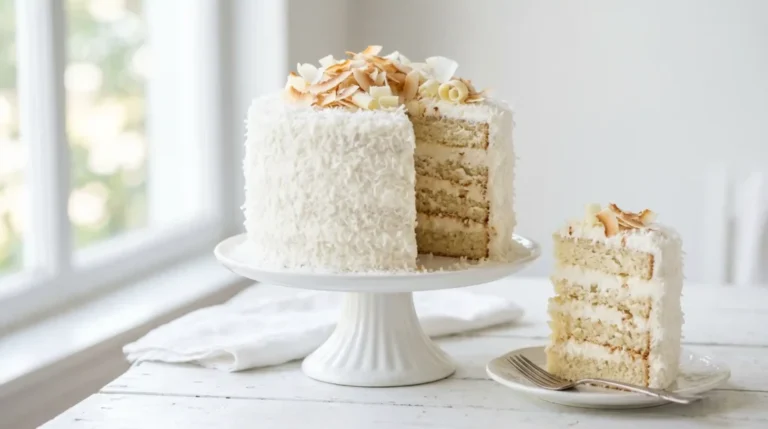
Coconut Cloud Cake
Ingredients
Method
- Preheat your oven to 175°C (350°F) and grease and flour two 23cm (9-inch) round cake pans or three 20cm (8-inch) pans.
- Whisk together the flour, baking powder, baking soda, and salt in a medium bowl and set aside.
- In a separate jug, stir together the room-temperature coconut milk and sour cream.
- In a large bowl, beat the softened butter and granulated sugar on medium-high speed for 4–5 minutes until pale and airy.
- Add the eggs one at a time, beating for 20–25 seconds after each addition, then mix in vanilla and coconut extract.
- Add the dry mixture and coconut milk mixture in alternating stages, starting and ending with dry ingredients.
- Divide the batter evenly between the prepared pans and bake for 28–32 minutes until a toothpick comes out clean.
- Allow the cakes to cool in the pans for 15 minutes, then transfer to a wire rack to cool completely for at least 90 minutes.
- Beat softened cream cheese until smooth, then add softened butter and beat until uniform.
- Gradually mix in sifted powdered sugar, then add coconut extract and beat until fluffy.
- Gently fold in the thawed whipped topping until fully combined.
- Spread the coconut flakes in a single layer in a dry skillet over medium heat and stir constantly until golden.
- Remove from heat and cool on a plate.
- Place the first fully cooled cake layer on a serving plate. Apply a layer of frosting on top.
- Place the second layer on top, apply a thin crumb coat over the entire exterior and refrigerate for 15 minutes.
- Frost the cake with a final smooth coat of frosting and immediately press sweetened shredded coconut against the sides.
- Top with toasted coconut flakes and refrigerate for at least 30 minutes before slicing.