Servings: 20–24 sandwich cookies | Prep Time: 45 minutes | Rest Time: 30–60 minutes | Bake Time: 14–16 minutes | Total Time: About 2 hours
Let’s be honest — Parisian macarons have a reputation for being intimidating. One wrong move and you end up with cracked shells and a minor identity crisis. But here’s the thing: once you understand what’s actually happening in each step, these Raspberry Pistachio Parisian Macarons become completely doable.
I made my first batch three years ago and produced what can only be described as pistachio-flavored hockey pucks. But I kept at it, and now this flavor combo is my absolute favorite. Sweet, nutty, tangy — it’s a genuinely perfect trio.
What Makes Raspberry Pistachio Parisian Macarons Special
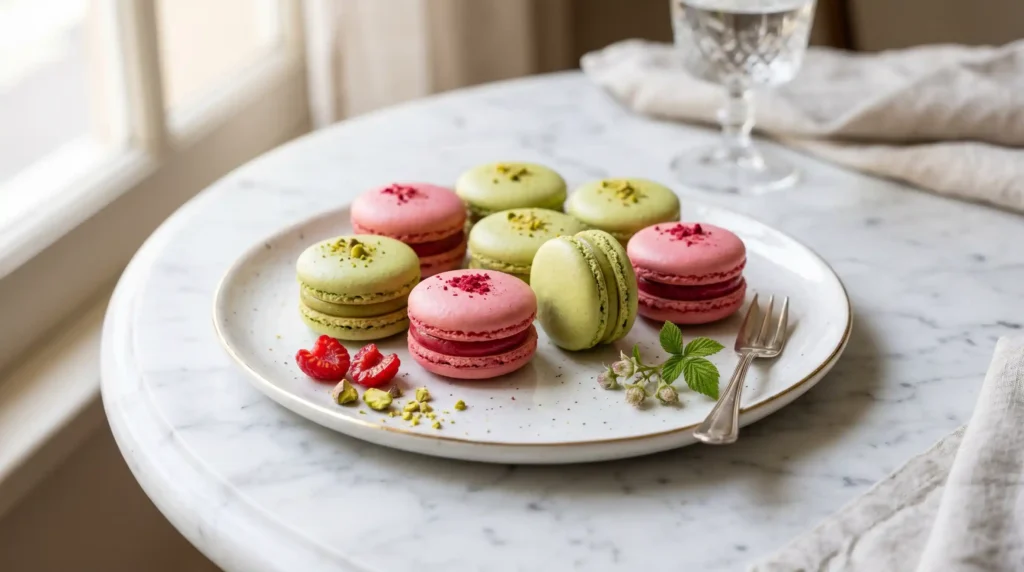
Parisian macarons are those delicate, sandwich-style French cookies with smooth domed shells and ruffled “feet” at the base. They’re not the same as coconut macaroons — FYI, that mix-up happens constantly and it’s a whole thing.
The pistachio shells bring an earthy, buttery richness. The raspberry buttercream filling cuts right through that richness with bright, tart flavor. Together, they create a macaron that tastes like it belongs in a Parisian patisserie window.
Ingredients You’ll Need
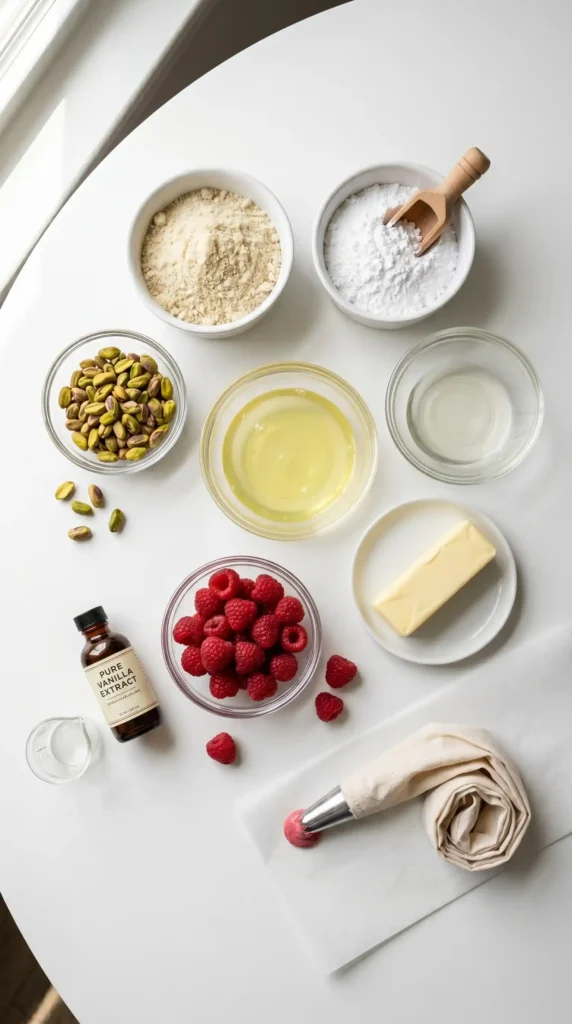
Keep everything measured and at room temperature before you start. Macaron baking rewards precision — this isn’t the place to eyeball anything.
For the Pistachio Macaron Shells:
- 100g almond flour, finely ground
- 50g raw pistachio flour (or finely ground, unsalted pistachios)
- 200g powdered sugar, sifted
- 150g aged egg whites, room temperature (about 4–5 large eggs)
- 75g granulated sugar
- 1/4 tsp cream of tartar
- 1–2 drops green gel food coloring (optional)
For the Raspberry Buttercream Filling:
- 115g unsalted butter, softened to room temperature
- 240g powdered sugar, sifted
- 3 tbsp fresh raspberry puree (strained, seeds removed)
- 1 tsp vanilla extract
- Pinch of salt
- 1–2 tsp heavy cream (if needed for consistency)
Equipment You’ll Need
Having the right tools matters here. You don’t need anything exotic, but a few specific items make the process much smoother.
- Stand mixer or hand mixer with whisk attachment
- Kitchen scale (non-negotiable — volume measurements won’t work)
- Fine mesh sieve or sifter
- Silicone spatula
- Piping bags fitted with a round 1/2-inch tip
- Baking sheets lined with silicone mats or parchment paper
- Oven thermometer
How to Make Raspberry Pistachio Parisian Macarons
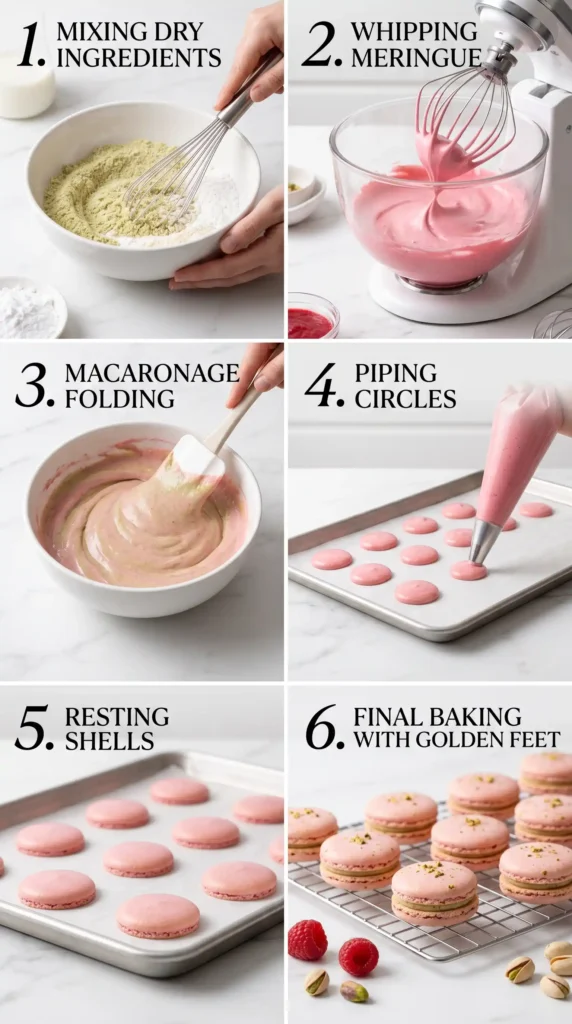
Take a breath. Read through the whole process once before you start. You’ve got this.
Step 1: Age Your Egg Whites
Age your egg whites at least 24 hours ahead of time. Separate the eggs, place the whites in a clean bowl, and refrigerate them uncovered overnight. This removes excess moisture and gives you a more stable meringue.
Pull them out of the fridge about 1 hour before you start baking. Room temperature egg whites whip up better and faster than cold ones. Cold whites give you a denser, weaker meringue — and a weak meringue means sad, flat shells.
Step 2: Make the Pistachio Almond Flour Mix
Combine the almond flour, pistachio flour, and powdered sugar in a bowl. Whisk them together briefly, then sift the entire mixture through a fine mesh sieve into a large bowl below.
Discard any large pieces that don’t pass through the sieve. If your pistachio flour is a bit coarse, run it through a food processor first, then re-sift. Lumps in your dry mix lead to bumpy shells — and nobody wants a lumpy macaron shell when they’re going for that glossy, smooth look.
Step 3: Make the French Meringue
Pour the aged egg whites into a completely clean, grease-free bowl. Even a tiny bit of grease will prevent the whites from whipping properly. Start beating on medium speed until the whites look foamy and opaque.
Add the cream of tartar. Increase the speed to medium-high and gradually add the granulated sugar, one tablespoon at a time. Keep beating until you reach stiff, glossy peaks. When you lift the whisk, the meringue should hold a firm point that doesn’t droop. If you’re adding gel food coloring, fold it in now with a gentle swipe of the spatula.
Step 4: Macaronage — The Most Important Step
Fold the sifted dry ingredients into the meringue. This folding process is called macaronage, and it’s the step that makes or breaks your shells. Use a silicone spatula and fold in wide, sweeping circles — scraping from the bottom up and pressing the batter gently against the side of the bowl.
You’re intentionally deflating the meringue slightly. Stop when the batter flows slowly off the spatula in a thick ribbon and falls back on itself within about 10 seconds. If it falls off in clumps, keep folding. If it runs off in a thin stream, you’ve over-mixed — and that batch is tough to save. The texture should look like thick lava: slow-moving and glossy.
Step 5: Pipe the Shells
Transfer the batter to a piping bag fitted with a round tip. Hold the bag perfectly straight up and down — not at an angle — about half an inch above the parchment-lined baking sheet. Pipe rounds about 1.5 inches in diameter, leaving 2 inches between each one.
Once you’ve piped the whole sheet, lift it about 4 inches off the counter and drop it firmly. Do this 3–5 times. This knocks out large air bubbles that would otherwise cause cracks during baking. If you see small peaks on top of each piped circle, wet your fingertip and gently smooth them down.
Step 6: Rest the Shells
This step tests patience, but it’s non-negotiable. Let the piped shells sit at room temperature for 30–60 minutes. You’ll know they’re ready when you lightly touch one and it doesn’t stick to your finger.
That dry skin forms a barrier on top of the shell. When the heat hits in the oven, the batter expands upward and forces the feet to form at the base. No skin equals no feet — and feet are what separates a true Parisian macaron from a regular sandwich cookie.
Step 7: Bake the Shells
Preheat your oven to 300°F (150°C) and place your oven rack in the center position. Use an oven thermometer to verify the actual temperature — oven dials lie more often than you’d think.
Bake one sheet at a time for 14–16 minutes. The shells should not jiggle when you gently nudge the pan. If they wobble, give them another minute or two. When done, slide the parchment sheet off the pan and let the shells cool completely on a flat surface before attempting to peel them. Rushing this step is how shells tear.
Step 8: Make the Raspberry Buttercream
Beat the softened butter with a hand or stand mixer on medium-high speed for about 3–4 minutes until it’s pale, fluffy, and noticeably lighter in color. This extra beating time makes the buttercream smooth and airy rather than dense and greasy.
Add the sifted powdered sugar in two additions, beating well after each. Then add the raspberry puree, vanilla extract, and a pinch of salt. Beat on medium speed for another 2 minutes until everything comes together into a smooth, vibrant pink filling. If it looks too thick, add heavy cream one teaspoon at a time until you hit a pipeable consistency.
Step 9: Fill and Assemble
Match your shells into pairs by size — a little visual sort before filling makes the finished cookies look much more professional. Transfer the buttercream into a piping bag and pipe a generous dollop onto the flat side of one shell in each pair.
Press the matching shell on top with a gentle twist, just enough to push the filling to the edges without squishing it out. Don’t skip the twist — it helps the filling adhere evenly. Place the finished macarons in an airtight container and refrigerate for at least 24 hours before serving.
Step 10: Mature and Serve
Maturing is the secret that most beginner recipes skip over. That 24-hour rest in the fridge allows the buttercream moisture to slightly soften the shells from the inside. The result? A macaron with the classic delicate crunch on the outside and a soft, chewy interior.
Pull them out of the fridge 20–30 minutes before serving so they come to room temperature. Cold macarons taste fine, IMO, but room temperature ones taste like a completely different (and much better) experience.
Common Mistakes and How to Avoid Them
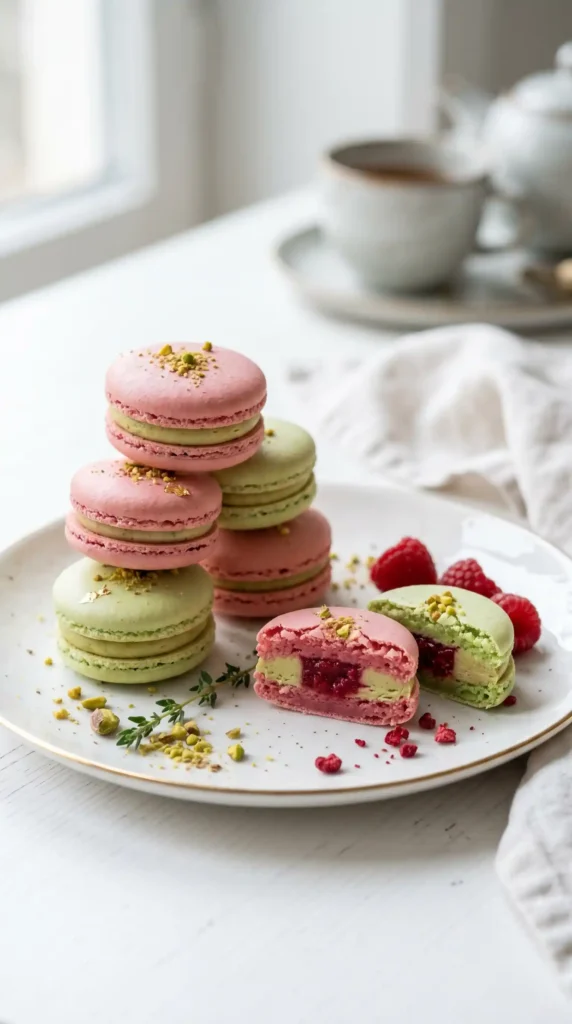
Even experienced bakers run into problems. Here’s what to watch for:
- Cracked shells: Usually caused by skipping the resting step or having the oven too hot.
- No feet: Under-mixed batter, wet egg whites, or shells that didn’t form a dry skin.
- Hollow shells: Over-whipped meringue or too-high oven temperature.
- Chewy, sticky texture after baking: Shells need more time in the oven.
- Uneven browning: Rotate the pan halfway through baking.
Storage Tips
Store assembled macarons in an airtight container in the refrigerator for up to 5 days. They actually taste better on days 2 and 3, once they’ve fully matured.
You can also freeze unassembled shells in a zip-lock bag for up to 1 month. Make fresh buttercream when you’re ready to fill and serve.
FAQs About Raspberry Pistachio Parisian Macarons
Q: Why do my macaron shells keep cracking? Cracking usually happens for one of two reasons: the shells didn’t rest long enough before baking, or your oven runs hot. Always verify your oven temperature with a separate thermometer. Even a 10-degree difference can crack shells.
Q: Can I use regular pistachios instead of pistachio flour? Yes. Blanch raw, unsalted pistachios to remove the skins, then dry them completely and process in a food processor until finely ground. Sift them carefully before use. The texture won’t be quite as fine as commercial pistachio flour, but it works well.
Q: Why do macarons need to rest before baking? Resting allows the outer layer of the piped batter to dry into a skin. That skin forces the expanding batter to push downward during baking, which creates the signature ruffled “feet” at the base of the shell. No skin, no feet.
Q: Can I make macarons without a stand mixer? A hand mixer works fine. The key is getting the meringue to truly stiff, glossy peaks — which takes about 8–10 minutes with a hand mixer. Just make sure your bowl and beaters are completely grease-free before you start.
Q: How do I know when my macarons are done baking? Gently nudge the pan. A finished macaron shell should not wobble or jiggle at all. It should feel set and firm when you lightly touch the top. If it moves, give it another 1–2 minutes before checking again.
Final Thoughts
Raspberry Pistachio Parisian Macarons look like they require a culinary degree, but they really just require patience and a kitchen scale. Once you understand what each step is doing and why, the process stops being intimidating and starts being genuinely fun.
Make a batch this weekend. Accept that the first one might not be perfect — and that’s completely fine. Every batch teaches you something. By your third attempt, you’ll be the person everyone begs to bring macarons to every gathering.
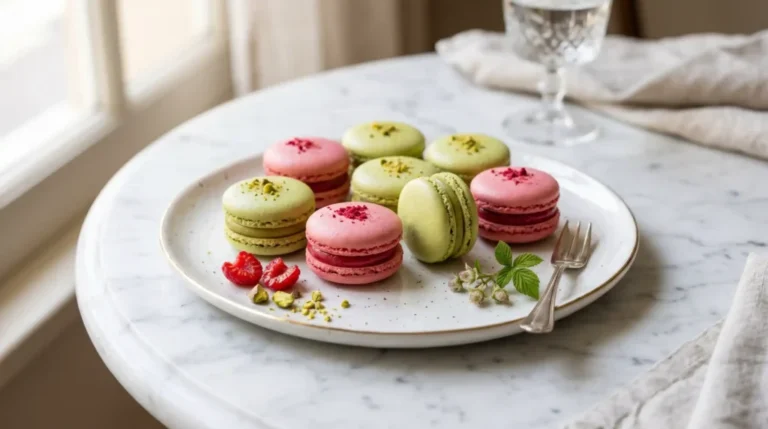
Raspberry Pistachio Parisian Macarons
Ingredients
Method
- Age your egg whites at least 24 hours ahead of time. Separate the eggs, place the whites in a clean bowl, and refrigerate them uncovered overnight.
- Combine the almond flour, pistachio flour, and powdered sugar in a bowl. Whisk briefly, then sift the mixture into a large bowl.
- Pour the aged egg whites into a clean bowl and start beating on medium speed until foamy and opaque. Add the cream of tartar, then gradually add granulated sugar, beating until you reach stiff peaks.
- Fold the sifted dry ingredients into the meringue using a silicone spatula in a macaronage technique until the batter flows off the spatula in a thick ribbon.
- Transfer the batter to a piping bag fitted with a round tip. Pipe rounds about 1.5 inches in diameter on parchment-lined baking sheets.
- Let the piped shells sit at room temperature for 30–60 minutes until a skin forms.
- Preheat your oven to 300°F (150°C) and bake the shells for 14–16 minutes.
- Cool the shells completely on a flat surface before attempting to peel them.
- For the buttercream, beat softened butter until light, then add powdered sugar in two additions, raspberry puree, vanilla, and salt. Beat until smooth.
- Match shells by size, pipe buttercream on one flat side, and gently press a matching shell on top.
- Refrigerate assembled macarons for at least 24 hours before serving.