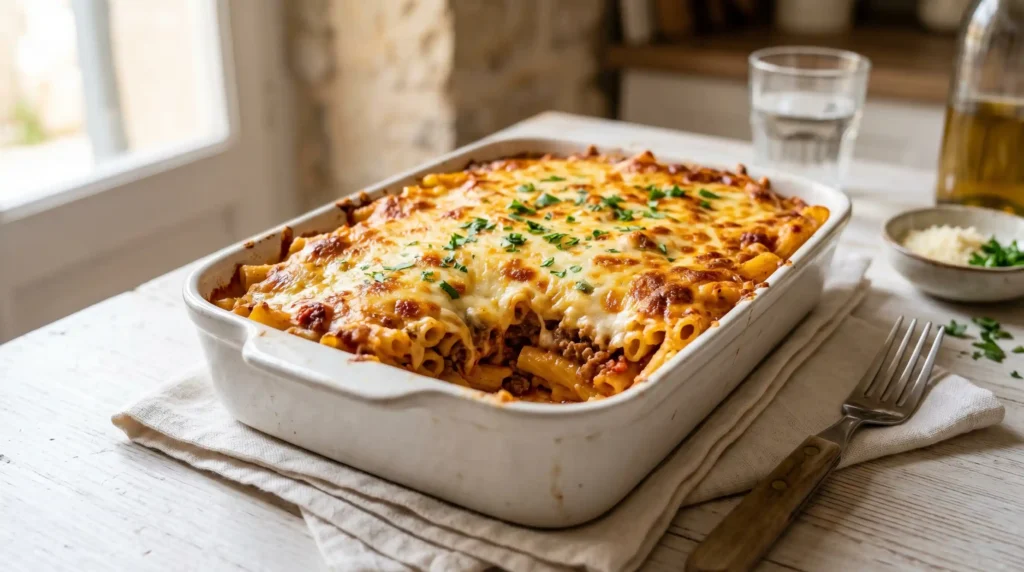
Malta sits in the middle of the Mediterranean and its cuisine reflects centuries of influence from Italy, North Africa, and the Levant. Macarona Forn — literally “baked macaroni” in Maltese — shows all three of those influences simultaneously in a single dish: Italian pasta and béchamel, Levantine warm spicing with cinnamon and allspice, and the generous, family-table spirit that Mediterranean cooking consistently applies to everything. It is the kind of dish that fills a kitchen with extraordinary smells and empties a table in twenty minutes.
I made Macarona Forn for the first time after spending time in Malta and developing a serious obsession with the dish that I could not replicate at any restaurant back home. The first attempt was close. The third attempt was correct — once I understood that the cinnamon is not optional or decorative but genuinely central to the flavour identity of the dish, and that the béchamel layer needs to be significantly thicker than I had initially made it. Both adjustments transformed a good pasta bake into something that tasted exactly like the original.
Have you ever eaten a dish in another country and spent the next six months trying to recreate it at home? This is that dish for Malta. Let us build it properly.
What Makes Macarona Forn Different From Other Baked Pasta Dishes
Macarona Forn occupies an interesting position in the world of baked pasta — it shares structural elements with both Italian pastitsio and Greek pastitsio, but its seasoning belongs firmly to the Maltese kitchen. The cinnamon and allspice in the meat sauce give it a warm, aromatic quality that Italian pasta bakes typically do not use and that Greek versions include more mildly. This warm spicing against the savoury tomato meat sauce and creamy béchamel is what makes Macarona Forn taste distinctly itself.
The béchamel layer is heavier and thicker than what you would find in a lasagne — it functions as a binding layer that holds the top of the pasta together and creates the characteristic golden crust that defines a properly baked version. A thin béchamel produces a runny top layer that does not set properly in the oven. A properly thick béchamel sets to a custard-like consistency that slices cleanly and holds its shape on the plate — the distinction between a pasta bake that falls apart when served and one that looks genuinely impressive.
The dual cheese topping — mozzarella for melt and stretch, Parmesan for flavour and golden crust — also differentiates Macarona Forn from simpler pasta bakes. Mozzarella alone produces a pale, rubbery top. Parmesan alone produces a dry, grainy surface. Together, they produce the deep golden, slightly crispy, stretch-when-pulled cheese top that makes every person at the table want the corner piece where the crust is most intense. IMO, always fight for the corner piece.
What You Need
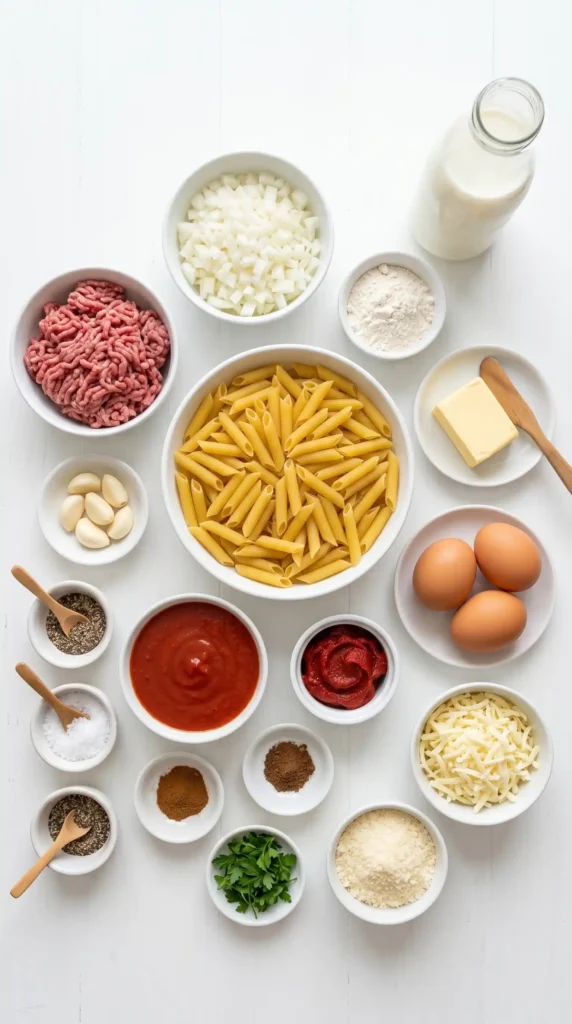
Three components, all using ingredients that are genuinely accessible everywhere. The ground beef can be replaced with ground lamb for a more traditional Maltese flavour — lamb’s slightly gamey richness pairs beautifully with the warm spices. If using a mix of both, use 60% beef and 40% lamb for a result that keeps the beef’s structural firmness while gaining the lamb’s distinctive flavour depth.
For the Pasta
- 500g macaroni pasta — penne, ziti, or any tubular pasta all work; the tube shape captures the meat sauce inside each piece
- Salt for the pasta cooking water
Now For the Spiced Meat Sauce
- 500g ground beef or ground lamb (or a mixture of both)
- 1 large onion, finely chopped
- 2 garlic cloves, finely minced
- 400g tomato sauce (passata or canned crushed tomatoes)
- 2 tablespoons tomato paste
- 1 teaspoon ground cinnamon — do not skip or reduce this; it is the flavour signature of the dish
- 1 teaspoon ground allspice
- Salt and black pepper to taste
- 2 tablespoons olive oil for cooking
For the Béchamel Sauce
- 4 cups (960ml) whole milk
- 1/2 cup (113g) unsalted butter
- 1/2 cup (60g) all-purpose flour
- Salt and white pepper to taste
- Pinch of freshly grated nutmeg (optional but traditional)
- 2 eggs, lightly beaten (for incorporating into the béchamel to create a firmer, custard-like set)
Now For the Cheese Topping
- 1 cup (100g) shredded mozzarella cheese
- 1 cup (100g) grated Parmesan cheese
The Cinnamon Is Not Optional — It Defines This DishFirst-time Macarona Forn makers sometimes feel uncertain about a teaspoon of cinnamon in a savoury meat sauce. Do not reduce it. Cinnamon in savoury meat dishes is a centuries-old Mediterranean and Middle Eastern tradition that produces warmth and aromatic depth rather than sweetness — at the quantity used here, the cinnamon does not read as sweet or dessert-like. It reads as warm, complex, and distinctive. Reducing it produces a pasta bake that tastes like any other pasta bake. Keeping it produces Macarona Forn. FYI — this is the most important single instruction in the recipe.
How to Make Macarona Forn Step by Step
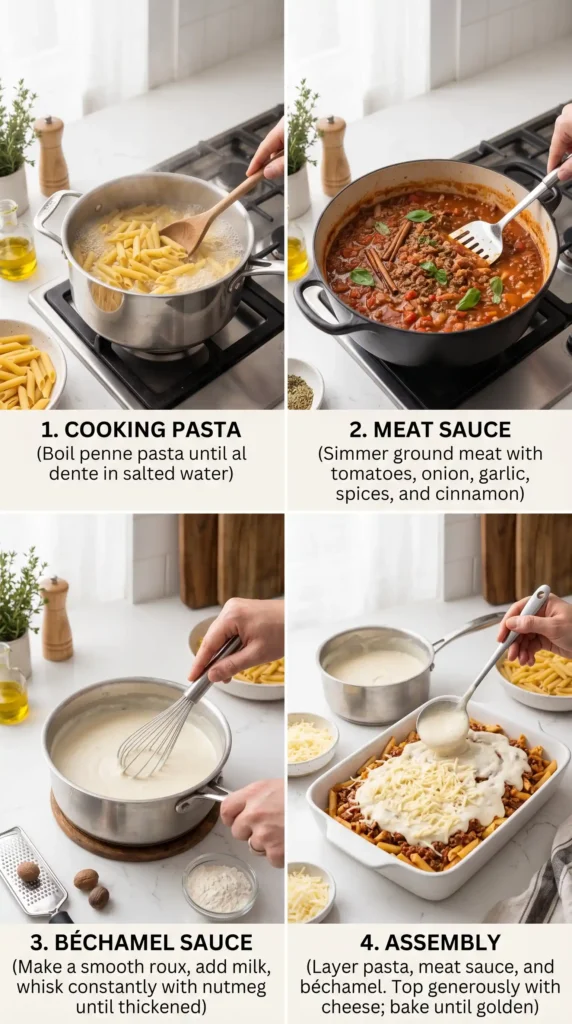
Three stages running in parallel: cook the pasta, make the meat sauce, and make the béchamel. The meat sauce and pasta can be made ahead on the same day or even the evening before — this actually improves the flavour of the meat sauce significantly as the spices have time to deepen. The béchamel should be made fresh just before assembly. Let us walk through each stage properly.
Step 1: Cook the Pasta
Bring a large pot of well-salted water to a full rolling boil. Add the macaroni and cook until 2 minutes short of the packet’s al dente time — the pasta will continue cooking in the oven during baking and slightly overcooked pasta produces a mushy bake rather than the defined, firm pasta pieces that hold their shape through the sauce and béchamel. Drain the pasta, toss briefly with a drizzle of olive oil to prevent sticking, and set aside.
Step 2: Make the Spiced Meat Sauce
Heat the olive oil in a large sauté pan over medium-high heat. Add the finely chopped onion and cook for 5–6 minutes, stirring occasionally, until soft and lightly golden around the edges. Once softened, stir in the minced garlic and cook for about 60 seconds, stirring constantly until fragrant and lightly colored.
Add the ground beef or lamb to the pan. Break the meat into small pieces using a wooden spoon or spatula — work it into the smallest possible crumble rather than leaving large chunks, which produce an uneven texture throughout the bake. Cook over medium-high heat, stirring frequently, until the meat shows no pink and looks deeply browned throughout — about 8–10 minutes. Browning the meat properly rather than just cooking it through produces significantly more flavour through the Maillard reaction on the meat surfaces.
Stir the tomato paste into the browned meat and cook it for about 2 minutes, mixing well as it coats the crumbles. This quick cooking step deepens the flavor and removes the slightly metallic taste of raw tomato paste. Pour in the tomato sauce and stir until combined, then season with the cinnamon, allspice, salt, and black pepper.Stir thoroughly to distribute the spices evenly throughout the sauce.
Reduce the heat to medium-low and allow the sauce to simmer for 15–20 minutes, stirring occasionally, until it thickens and the oil separates slightly at the surface — a sign that the sauce has reduced properly and the flavours have concentrated. The finished meat sauce should look thick and cohesive rather than liquid and should taste deeply savoury with a clear warm spice note from the cinnamon and allspice. Taste and adjust salt and pepper. Set aside to cool slightly while you make the béchamel.
Step 3: Make the Béchamel Sauce
Melt the butter in a medium, heavy-bottomed saucepan over medium heat. Once the butter melts and stops foaming, add all the flour at once and immediately whisk vigorously to combine the flour and butter into a smooth paste — this paste is the roux that will thicken the béchamel. Cook the roux for 2 minutes, whisking constantly, until it smells faintly nutty and the raw flour taste has cooked out. Do not let it brown.
Begin adding the whole milk slowly — not all at once, which would produce lumps that are difficult to remove. Add approximately 1/4 cup of milk first and whisk vigorously until completely smooth and the milk is fully incorporated. Add another 1/4 cup and repeat. Continue adding the milk in small increments, whisking after each addition, until about half the milk is incorporated and the sauce looks thick and smooth. At this point you can add the remaining milk in a more continuous stream, whisking constantly.
Once all the milk is incorporated, continue cooking the béchamel over medium heat, whisking frequently, for 5–8 minutes until it thickens to a consistency similar to very thick cream — it should coat the back of a spoon heavily and leave a clean track when a finger is drawn across the coated spoon. This thickness is more substantial than a standard béchamel for lasagne. Season with salt, white pepper, and a pinch of nutmeg if using.
Remove the béchamel from the heat and allow it to cool for 3–4 minutes. Then add the two lightly beaten eggs and whisk them into the warm béchamel quickly — adding eggs to screaming-hot béchamel would scramble them. The eggs enrich the sauce and ensure it sets to a firm, sliceable layer in the oven rather than remaining loose. Set aside.
Step 4: Assemble the Macarona Forn
Preheat your oven to 190°C (375°F). Grease a large, deep baking dish — approximately 30x22cm works well for this quantity. Combine the drained pasta with the meat sauce in the sauté pan or a large bowl and toss until every pasta piece is coated in the meat sauce. Spread this pasta-meat mixture evenly across the base of the greased baking dish, pressing it down slightly to compact it into an even layer.
Pour the béchamel sauce over the pasta layer, spreading it from edge to edge with a spatula to completely cover the pasta. The béchamel should look like a thick, even white blanket over the pasta — no gaps and no sections where the pasta shows through the white layer. Scatter the shredded mozzarella across the béchamel in an even layer, then scatter the grated Parmesan over the mozzarella to complete the cheese topping.
Step 5: Bake Until Golden and Set
Place the assembled Macarona Forn on the centre rack of the preheated oven. Bake for 35–40 minutes until the top is deeply golden and slightly crispy at the edges, the cheese shows a mixed pattern of golden-brown spots across the surface, and the sides bubble visibly around the edges. The béchamel under the cheese should look set rather than liquid when you gently press the top surface.
Remove from the oven and allow the finished Macarona Forn to rest for 15 minutes before cutting and serving. The resting period is essential — a just-removed baking dish produces liquid that flows when cut. After 15 minutes, the béchamel sets sufficiently to hold clean, defined portions when served with a large spoon or spatula. The resting period also allows the flavours to settle and the cheese crust to firm slightly, making portioning clean and visually impressive.
Variations Worth Making
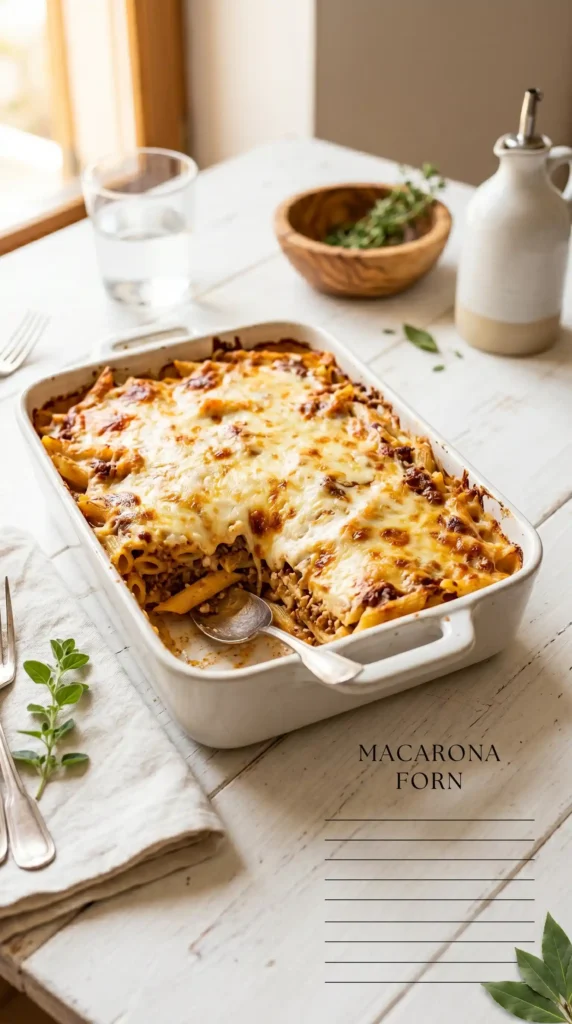
Chicken Macarona Forn
Replace the ground beef with 500g of finely diced or minced cooked chicken. The chicken version is lighter in flavour and colour than the beef version — reduce the cinnamon to 1/2 teaspoon and add a teaspoon of dried oregano to compensate for the milder protein. The chicken Macarona Forn produces a subtler, more delicate flavour that suits summer and light-occasion serving better than the heavier beef version.
Vegetarian Macarona Forn
Replace the ground meat with 400g of finely diced eggplant (aubergine) combined with 200g of brown lentils, cooked. Salt the diced eggplant, let it sit for 20 minutes, and pat dry before adding to the pan with the onion. The lentils provide the protein body and the eggplant absorbs the tomato and spice flavours deeply during cooking. The vegetarian version is genuinely satisfying and the warm spice profile works as beautifully with vegetables as it does with meat.
Storage and Make-Ahead Tips
Store leftover Macarona Forn in an airtight container in the refrigerator for up to 4 days. It reheats excellently — individual portions reheat in the microwave for 2–3 minutes, or the whole dish reheats covered in a 180°C oven for 20 minutes. The reheated version is often considered better than the fresh version by Maltese households, as the spices deepen overnight and the béchamel sets even more firmly into the pasta.
The meat sauce can be made up to 3 days in advance and stored covered in the fridge or frozen for up to 3 months. Making the sauce ahead and freezing it transforms Macarona Forn from a 90-minute weeknight commitment into a 45-minute bake using pre-made components. The béchamel should always be made fresh on the day of assembly — stored béchamel separates and develops an unpleasant skin that affects the texture of the finished bake.
Frequently Asked Questions
What does Macarona Forn mean?
Macarona Forn is Maltese for “baked macaroni” — macarona being the Maltese word for pasta (specifically macaroni) and forn meaning “oven” or “baked.” The dish is a cornerstone of traditional Maltese home cooking, typically made on Sundays and for family gatherings. It represents the intersection of Italian pasta culture (historically strong in Malta due to the island’s proximity to Sicily) and the warm-spiced cooking traditions of North African and Levantine cuisines that influenced Malta through centuries of trade and cultural exchange.
Is Macarona Forn the same as Greek pastitsio?
Similar but distinct. Both dishes use baked pasta with a meat sauce and béchamel topping and both reflect shared Mediterranean culinary history. The primary differences are in the spicing — Macarona Forn uses cinnamon and allspice more assertively than most Greek pastitsio versions. Greek pastitsio also traditionally uses a specific thick pasta called bucatini or pastitsio pasta. The Maltese version uses regular macaroni or penne and reflects the slightly more North African spice influence in Maltese cuisine compared to Greek.
Can I make Macarona Forn the night before and bake it the next day?
Yes — and this is one of its most practical qualities for hosting. Assemble the entire dish the evening before, cover tightly with cling film, and refrigerate overnight. Bake directly from the refrigerator the next day, adding 10–15 minutes to the total baking time to account for the cold starting temperature. The overnight rest actually improves the dish — the spices in the meat sauce penetrate the pasta more deeply, and the béchamel and pasta layers compress into each other and produce a more cohesive, unified result than a same-day bake.
Why does my béchamel have lumps?
Lumps in béchamel almost always result from adding too much milk too quickly before the previous addition was fully whisked in. Add the first half of the milk in small, 1/4-cup increments with vigorous whisking between each addition — this is the stage where lumps form if the liquid is added too fast. Once the sauce is smooth and thick from the first half of the milk, the remainder can go in more freely. If lumps form anyway, strain the béchamel through a fine mesh sieve before adding the eggs and using it in the recipe.
Can I use different pasta shapes for Macarona Forn?
Yes — any short, tubular pasta works well. Penne is the most commonly used substitute and produces essentially identical results to macaroni. Ziti is another excellent option. Rigatoni works but is larger and produces bigger individual pasta pieces that some people find too chunky in a bake. Avoid long pasta like spaghetti or linguine, which is difficult to portion cleanly from a baking dish and does not capture the meat sauce inside each piece in the way that tubular pasta does. Short, tubular shapes produce the best overall result.
Final Thoughts
This Macarona Forn earns its reputation as one of the most deeply satisfying, deeply flavourful, and deeply Maltese dishes in the island’s culinary tradition. The warm spiced meat sauce, the thick, egg-enriched béchamel, and the golden cheese crust come together into something that tastes more complex and more intentional than the sum of its fourteen ingredients — and that feeds a large table generously from a single baking dish that takes 90 minutes to produce.
Make the meat sauce bold with cinnamon. Make the béchamel thick and generous. Let the finished bake rest before cutting. These three decisions produce a Macarona Forn that honours the dish’s tradition and satisfies everyone at the table regardless of whether they have visited Malta or heard of the dish before. It earns its place in any regular dinner rotation without question.
Start the meat sauce while the pasta water heats. Make the béchamel while the sauce simmers. Assemble, bake, and then wait the full fifteen minutes before cutting — that last instruction is the most difficult and the most important. IMO, the corner piece is worth the wait and then some.
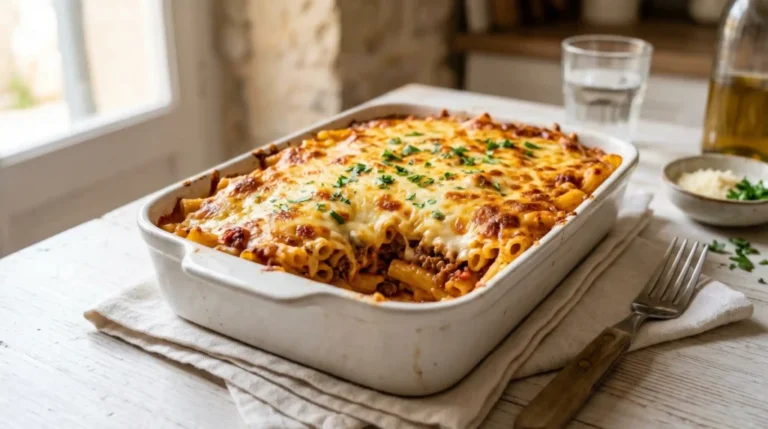
Macarona Forn
Ingredients
Method
- Bring a large pot of well-salted water to a full rolling boil. Add the macaroni and cook until 2 minutes short of the packet's al dente time. Drain the pasta, toss with olive oil to prevent sticking, and set aside.
- Heat olive oil in a large sauté pan over medium-high heat. Add finely chopped onion and cook for 5–6 minutes until soft and golden.
- Stir in minced garlic and cook for about 60 seconds, stirring constantly.
- Add ground beef or lamb and break into smaller pieces. Cook until browned, about 8–10 minutes.
- Stir in tomato paste, cooking for 2 minutes, then add tomato sauce and season with cinnamon, allspice, salt, and black pepper. Simmer for 15–20 minutes until thick.
- Melt the butter in a saucepan over medium heat. Add flour and whisk to combine into a roux. Cook for 2 minutes.
- Slowly whisk in milk until smooth, then continue cooking until thickened, about 5–8 minutes. Season with salt, white pepper, and nutmeg.
- Remove from heat, allow to cool slightly, and quickly whisk in beaten eggs.
- Preheat oven to 190°C (375°F). Grease a large baking dish. Combine pasta with meat sauce and spread into the dish.
- Pour béchamel over pasta, then top with mozzarella and Parmesan.
- Bake for 35–40 minutes until the top is golden and bubbly. Let rest for 15 minutes before serving.